
Medicines
SmPC of 01/09/2025
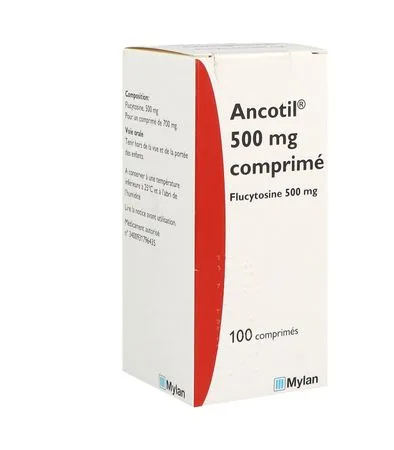
ANCOTIL 500 mg, tablet
Composition
Flucytosine.................................................................................................................................................. 500 mg
For one tablet.
Maize starch, microcrystalline cellulose, hydrated precipitated silica, povidone, magnesium stearate.
Indications
Severe systemic mycoses caused by susceptible organisms, as an alternative or follow-on to the parenteral route, in particular: candidiasis, cryptococcosis, chromomycosis and certain forms of aspergillosis.
Combination with another antifungal:
It is essential to use flucytosine in combination in order to minimise as far as possible the selection of resistant mutants, particularly in the treatment of candidiasis and cryptococcosis.
The combination with amphotericin B is often synergistic and never antagonistic.
Dosage and administration
Oral use.
Dosage
Dosages vary from 100 to 200 mg/kg per day depending on the nature of the infection, its location and the susceptibility of the causative agent.
The daily dose must be divided into 3 or 4 oral doses.
Use in patients with renal impairment
Doses should be administered at longer intervals according to the following dosing schedule:
|
CREATININE CLEARANCE |
DOSE PER ADMINISTRATION |
INTERVAL |
|
|
≥ 40 ml/min |
25 to 50 mg/kg |
6 hours |
|
|
20≤Cl<40 ml/min |
25 to 50 mg/kg |
12 hours |
|
|
10≤Cl<20 ml/min |
25 to 50 mg/kg |
24 hours |
|
|
Cl < 10 ml/min |
Single dose of 25 mg/kg then plasma level check 12 hours after the initial dose, before repeating the dose. |
||
Patients on dialysis
Flucytosine being dialysable, the dose of this medicine must be renewed after each dialysis session.
In anuric patients or nephrectomised patients on haemodialysis, the initial dose must under no circumstances be renewed before the next dialysis session.
Hepatic impairment
The use of flucytosine has not been studied in patients with hepatic impairment.
Although hepatic impairment is not expected to have a significant effect on the pharmacokinetics of flucytosine, close monitoring is necessary in case of treatment with ANCOTIL in patients with hepatic impairment. (See section Warnings and precautions and section Pharmacokinetics)
Associations with other antifungals
The combination of flucytosine and amphotericin B is synergistic: it sometimes allows the dose to be reduced and decreases the risk of secondary resistance to flucytosine developing.
Close monitoring of renal function is necessary with this combination (see section Warnings and precautions).
There does not appear to be any antagonism with imidazole derivatives.
Elderly subjects
As clinical data on the use of flucytosine in elderly patients are limited, this medicine will only be used in these patients if the expected benefit outweighs the potential risks.
Particular attention must be paid to renal function in this population.
Paediatric population
The available data are not sufficient to support evidence-based dosage recommendations in paediatric patients, including full-term and premature newborns.
Flucytosine must not be used as first-line treatment or as monotherapy in paediatric patients. Flucytosine must be used in combination with other appropriate antifungal agents when other suitable medicines are not available and are unlikely to be effective.
Contraindications
Hypersensitivity to the active substance or to any of the excipients listed in section Composition.
Breast-feeding (see section Fertility, pregnancy and breastfeeding).
Proven complete deficiency of dihydropyrimidine dehydrogenase (DPD).
The combination with irreversible inhibitors of dihydropyrimidine dehydrogenase (DPD), such as brivudine, sorivudine and their analogues, or uracil, a reversible DPD inhibitor, is contraindicated (see section Warnings and precautions.).
Concomitant use of flucytosine and the combination tegafur/gimeracil/oteracil (of which tegafur is a prodrug of 5-FU and gimeracil a reversible DPD inhibitor) (see sections Warnings and precautions and Interactions).
Warnings and precautions
Treatment with this medicine will be initiated after identification of the strain and assessment of its susceptibility to flucytosine, given possible primary resistance. It will be continued under regular medical supervision.
Special monitoring
It is recommended to perform a full blood count and liver function tests (ALT, AST, alkaline phosphatases) before starting treatment, then regularly throughout treatment, particularly in the period following initiation.
Patients with hepatic impairment may be treated with flucytosine, but close clinical and biological monitoring (AST, ALT, alkaline phosphatases) of hepatic function is necessary, together with monitoring of plasma flucytosine levels.
This medicine must be used with caution in patients with bone marrow aplasia or blood dyscrasia, as well as in patients treated with immunosuppressants or cytostatics; due to a high risk of haematological damage, rigorous clinical and biological monitoring (full blood count) must be put in place, together with monitoring of plasma flucytosine levels.
Warnings regarding renal function
As the elimination of this medicine is exclusively renal, in cases of renal impairment or association with a nephrotoxic medicine likely to alter renal function, creatinine clearance must be regularly monitored and the dose adjusted according to this clearance (see section Dosage and administration).
65 to 75% of the Ancotil present in the body is eliminated by haemodialysis. Consequently, in dialysed patients, administration of this medicine must be renewed after each dialysis or purification session.
Interference with biological measurements
Creatinine measurement: flucytosine may influence the two-step enzymatic measurement of creatinine levels and lead to falsely positive diagnoses of azotemia. Other methods are therefore recommended for measuring creatinine levels.
Dihydropyrimidine dehydrogenase (DPD) enzyme deficiency
The 5-fluorouracil is a metabolite of flucytosine. DPD is an enzyme that plays a key role in the metabolism and elimination of 5-fluorouracil.
The risk of severe drug-related adverse effects is therefore increased when ANCOTIL is used in people with dihydropyrimidine dehydrogenase (DPD) deficiency. Determination of DPD activity may be considered when drug toxicity is confirmed or suspected.
If drug toxicity is suspected, discontinuation of treatment with ANCOTIL should be considered. A minimum interval of 4 weeks between treatment with sorivudine and other DPD-inhibiting analogues, such as brivudine, must be respected before treatment with Ancotil.
A minimum interval of 7 days between treatment with the tegafur/gimeracil/oteracil combination and initiation of treatment with Ancotil must be respected (see sections Contraindications and Interactions).
Monitoring of plasma flucytosine levels during treatment:
Flucytosine levels must be monitored in order to adjust the dosage accordingly.
The steady-state serum level should be on average 35 to 70 µg/ml. The sensitivity of most susceptible strains in vitro is characterized by a minimum inhibitory concentration between 10 and 25 µg/ml. However, values below 25 µg/ml should be avoided due to an increased risk of resistance developing at low concentrations. Prolonged serum levels above 100 µg/ml should be avoided due to the increased risk of haematological toxicity at high levels.
Contraception in men and women
Flucytosine is partially metabolised to 5-fluorouracil, which is genotoxic and is considered potentially teratogenic in humans. Women of childbearing potential must use effective contraception during treatment and for 6 months after treatment has ended. In cases of renal impairment, the contraception period must be extended by a further 2 months. Male patients (or their female partners of childbearing potential) must use effective contraception during treatment and for 3 months after treatment has ended (see section Fertility, pregnancy and breastfeeding). In cases of renal impairment, the contraception period must be extended by a further 2 months.
Paediatric population
Flucytosine has a narrow therapeutic index and there is a risk of potential toxicity at high systemic concentrations.
Due to the prolonged elimination of flucytosine in paediatric patients, particularly in full-term and premature newborns, administration of flucytosine may lead to exceeding optimal serum levels. Monitoring of plasma flucytosine levels based on local (or national) guidelines for antifungal treatment and dose adjustments, as needed, are necessary to avoid excessive exposure to flucytosine.
Blood count and renal function should be regularly monitored in paediatric patients during treatment to monitor creatinine concentration and clearance.
The tablets are not suitable for children who are unable to swallow solid forms.
Interactions
Contraindicated combinations (see section Contraindications)
+ Nucleoside antiviral anti-herpetic medicinal products (for example brivudine, sorivudine, and their analogues)
+ Uracil
Nucleoside antiviral anti-herpetic medicinal products (for example brivudine, sorivudine, and their analogues) or uracil are potent inhibitors of dihydropyrimidine dehydrogenase (DPD), the enzyme that metabolises fluorouracil (see sections Warnings and precautions and Interactions).
As fluorouracil is a metabolite of flucytosine, the combination of these medicinal products with Ancotil is contraindicated (see section Contraindications).
Concomitant use of the tegafur/gimeracil/oteracil combination (in which tegafur is a prodrug of 5-FU and gimeracil is a reversible DPD inhibitor) and flucytosine is contraindicated (see section Contraindications) as it may lead to additional toxicities.
Associations requiring precautions for use
+ Zidovudine
Increased haematological toxicity (additive bone marrow toxicity effects). More frequent monitoring of the blood count.
Associations to be taken into account
+ Ganciclovir, Valganciclovir
Increased haematological toxicity.
+ Cytotoxic agents
Increased haematological toxicity.
+ Immunosuppressants (ciclosporin, everolimus, sirolimus, tacrolimus, temsirolimus)
Increased haematological toxicity.
Fertility, pregnancy and breastfeeding
Contraception in men and women
Flucytosine is partially metabolised to 5-fluorouracil, which is genotoxic and is considered potentially teratogenic in humans (see section Preclinical safety : Preclinical safety data).
Women of childbearing potential must use effective contraception during treatment and for up to 6 months after treatment cessation. In cases of renal impairment, the contraception period must be extended by an additional 2 months. Male patients (or their female partners of childbearing potential) must use effective contraception during treatment and for up to 3 months after treatment cessation. In cases of renal impairment, the contraception period must be extended by an additional 2 months.
Pregnancy
Animal studies have demonstrated reproductive toxicity of flucytosine and one of its metabolites (5-fluorouracil) (teratogenicity and embryotoxicity) (see section Preclinical safety).
In humans, flucytosine crosses the placenta.
Data concerning the use of flucytosine in pregnant women are very limited.
Toxicity to the embryo or foetus cannot be excluded, particularly in case of exposure during the first trimester. Therefore, Ancotil must not be used during pregnancy and in women of childbearing potential without effective contraception, unless absolutely necessary in infections that are life-threatening and in the absence of an effective therapeutic alternative.
If Ancotil is administered during pregnancy, the patient must be informed of the teratogenic risk of Ancotil, and careful prenatal and postnatal monitoring must be conducted. Furthermore, if administration continues up to delivery, and given the safety profile of flucytosine, neonatal monitoring (haematological and hepatic) must be performed.
Breast-feeding
There are no data on the excretion of flucytosine in human milk.
Breastfeeding is contraindicated during treatment with flucytosine (see section Contraindications).
Adverse effects
The adverse reactions of flucytosine mainly affect the gastrointestinal tract, the liver and the bone marrow. Serious adverse reactions may occur with high serum concentrations of flucytosine (e.g. in cases of renal impairment, if the dose is not adjusted to the reduced capacity for renal excretion).
The assessment of adverse reactions is based on the following frequency categories:
Very common (≥ 1/10)
Common (≥ 1/100, < 1/10)
Uncommon (≥ 1/1 000, < 1/100)
Rare (≥ 1/10 000, < 1/1 000)
Very rare (< 1/10 000)
Frequency not determinable (cannot be estimated from the available data).
The following adverse reactions have been observed:
|
System Organ Classes |
Common |
Frequency not known |
|
Gastrointestinal disorders |
Nausea, diarrhoea, vomiting, abdominal pain |
Ulcerative colitis |
|
Blood and lymphatic system disorders |
|
Haematological disorders (such as anaemia, leukopenia, granulocytopenia, neutropenia, eosinophilia and thrombocytopenia), dependent on possibly elevated serum levels* Bone marrow toxicity** (irreversible) associated with pancytopenia and myelosuppression (aplasia, agranulocytosis) |
|
Hepatobiliary disorders |
Elevation of transaminase (AST, ALT) and alkaline phosphatase levels, regressing upon treatment discontinuation. |
Acute hepatitis, hepatocyte necrosis and hepatic cytolysis, sometimes with a fatal course |
|
Cardiac disorders |
|
Cardiac disorders usually of ischaemic type, myocardial toxicity, ventricular function disorders, cardiac arrest, tachycardia, arrhythmia |
|
Immune system disorders |
|
Urticaria, hypersensitivity |
|
Metabolism and nutrition disorders |
|
Hypokalaemia |
|
Psychiatric disorders |
|
Confusion, hallucinations |
|
Nervous system disorders |
|
Headache, sedation, convulsions, paraesthesia, peripheral neuropathy |
|
Ear and labyrinth disorders |
|
Vertigo |
|
Respiratory, thoracic and mediastinal disorders |
|
Dyspnoea, chest pain, respiratory arrest, acute respiratory failure |
|
Skin and subcutaneous tissue disorders |
|
Pruritus, maculopapular erythema, photosensitivity reaction, Lyell's syndrome |
|
Renal and urinary disorders |
|
Renal failure, increase in serum creatinine and blood urea |
|
General disorders and administration site conditions |
|
Fever |
* most often moderate and transient and more frequent in cases of renal insufficiency or when serum flucytosine levels are above 100 µg/ml.
** More severe effects, possibly irreversible and occasionally leading to death, have sometimes been observed, most often in patients also receiving treatment with bone marrow toxicity.
Reporting of suspected adverse reactions
Reporting suspected adverse reactions after authorisation of the medicinal product is important. It allows continued monitoring of the benefit/risk balance of the medicinal product. Healthcare professionals are asked to report any suspected adverse reaction via the national reporting system: National Agency for the Safety of Medicines and Health Products (ANSM) and the network of Regional Centres of Pharmacovigilance - Website:https://signalement.social-sante.gouv.fr/ .
Overdose
In case of overdose, which may in particular result from impaired renal function, an exaggeration of side effects, in particular haematological, is to be expected. The haemogram must therefore be monitored very strictly.
Pharmacodynamics
Pharmacotherapeutic class: antimycotic for systemic use, ATC code: J: General anti-infectives for systemic use.
Activity: fungistatic in humans, at therapeutic doses.
Natural spectrum: Candida serotype A, Cryptococcus neoformans, the agents of chromomycosis, and to a lesser degree: Aspergillus.
Mechanism of action
Cells of pathogens sensitive to Ancotil can absorb flucytosine (5-FC), which is then metabolised to 5-fluorouracil (5-FU) via a specific cytosine deaminase. The amount of 5-FU incorporated into the ribonucleic acids of the pathogen is proportional to the pathogen's sensitivity.
Possible resistance due to:
• Cases of primary resistance. Only a study in vitro of the strain in question makes it possible to assess its sensitivity.
• Risk of acquired resistance during treatment. Association with another antifungal is recommended.
Strains initially sensitive to Ancotil may acquire resistance during treatment. It is therefore recommended to assess the sensitivity of these strains before and also during treatment. (The method described by Shadomy and Speller is well suited). The use of 5-FC discs is recommended.
For some pathogen species, a synergy has been demonstrated in vitro and in vivo with a combination of Ancotil and amphotericin B, particularly pronounced in the case of organisms with reduced sensitivity to Ancotil.
Pharmacokinetics
Absorption
Administered orally, this treatment is absorbed at 90% by the digestive tract and produces the same concentrations as those observed after a short-duration IV infusion with an identical dose. After a single IV administration, the maximum serum concentrations are approximately equivalent, in microgram/ml, to the dose administered in mg/kg.
Distribution
The volume of distribution is between 0,5 and 1 l/kg. This medicine diffuses throughout the body, including into the CSF, binding very little (< 5 %) to plasma proteins.
Urinary concentrations of this medicine are always higher than plasma concentrations in patients with normal renal function.
Metabolism
More than 90% of the flucytosine dose is recovered unchanged in the urine. Flucytosine is metabolised (probably by intestinal bacteria) to 5-fluorouracil (5-FU). The ratio of plasma concentrations of 5-FU/5-FC is low.
Elimination
The plasma half-life is 3 to 6 hours. Elimination is rapid via the renal route, essentially by glomerular filtration, unchanged. In patients with renal impairment, the plasma half-life is prolonged; it is therefore necessary to adjust the dosage according to creatinine clearance (see section Dosage and administration).
Flucytosine is dialysable.
Paediatric population
The available data on the pharmacokinetic properties of flucytosine in paediatric patients are limited and suggest that the half-life of flucytosine is longer in children compared with adults (4 vs 7 h), particularly in newborns. A pharmacokinetic study in newborns showed that the half-life of flucytosine was twice as long as in adults, even though the maximum concentrations were comparable. In addition, the volume of distribution of flucytosine approximates the total body water volume due to its high solubility. In a retrospective study with 391 paediatric patients, 65% of residual flucytosine concentrations exceeded the normal reference value range.
Preclinical safety
Studies in vitro on the mutagenic potential of flucytosine are negative. No study is available on the carcinogenic potential of Ancotil.
Flucytosine is teratogenic and embryotoxic in rats receiving oral or parenteral doses of at least 40 mg/kg per day (240 mg/m2 or 0,043 times the daily dose in humans).
The 5-fluorouracil, a metabolite of flucytosine, is genotoxic in mice and in vitro, embryotoxic and teratogenic in mice and rats, and classified as potentially teratogenic in humans. Malformations (abnormalities of the nervous system, palate, skeleton, tail, limbs) have occurred in several species (including rats and Syrian hamsters).
Embryotoxic effects (small fetus, resorption) are also observed in monkeys treated with 5-fluorouracil.
Flucytosine and 5-fluorouracil cross the placental barrier.
Prescription, supply and reimbursement
| Marketing authorisation (AMM) |
|
| Price: |
|
Collection.
1 RUE DE TURIN
69007 LYON
Tel: 04 37 25 75 00 https://www.viatris.fr/
Source: VIDAL · Updated on 10/11/2026. This information does not replace advice from a healthcare professional.