
Medicines
SmPC of 06/01/2026
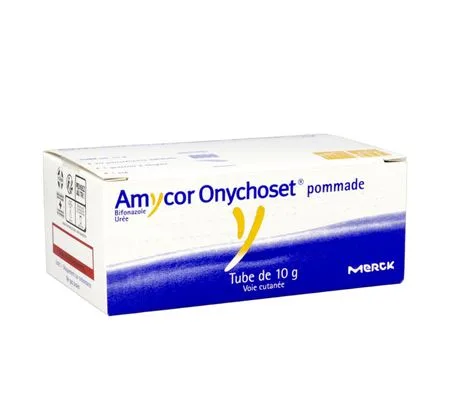
AMYCOR ONYCHOSET, ointment
Forms and presentations
Ointment.
Box containing: 1 tube of 10 g + 1 scraper + 20 adhesive dressings.
Composition
For 100 g of ointment:
Bifonazole: 1 g
Urea: 40 g
Excipient with known effect: wool fat (lanolin)
Wool fat, white beeswax, petrolatum.
Dosage and administration
Soak the foot and/or hand for approximately 10 minutes in warm water.
Apply once daily to the infected nail the necessary amount of AMYCOR ONYCHOSET ointment to cover the entire nail. Keep in place under an occlusive dressing for 24 hours.
After removing the dressing and before each renewal, soak the nail in warm water and remove the softened portion using the scraper. Renew the application of AMYCOR ONYCHOSET every 24 hours until complete removal of the infected portion of the nail. Depending on the extent of involvement and the thickness of the nail, 1 to 3 weeks of treatment are required.
AMYCOR ONYCHOSET acts only on the infected portion of the nail and has no effect on healthy areas.
After removal of the infected portion of the nail, antifungal treatment must be continued by daily application of AMYCOR cream at 1 % for 4 to 8 weeks.
Contraindications
Hypersensitivity to an imidazole antifungal or to any of the excipients listed in section Composition.
Warnings and precautions
Warnings:
- Despite the available clinical data, which are reassuring in this regard, and low transcutaneous passage, the experimental hepatic toxicity of this active ingredient administered systemically in several animal species should be noted.
- The occurrence of systemic effects is unlikely due to the very low rate of absorption of bifonazole during lysis of the pathological nail by AMYCOR ONYCHOSET.
- This medicine contains lanolin (wool fat) and may cause local skin reactions (for example: eczema).
Precautions for use
- Avoid contact with the eyes and mucous membranes.
- Wash hands after use.
Interactions
The data available to date do not suggest the existence of clinically significant interactions.
Fertility, pregnancy and breastfeeding
Pregnancy
Although no teratogenic effect has been observed in animal studies, it is recommended not to administer this product during the first trimester of pregnancy.
Adverse effects
Some signs of local irritation (redness, irritation, maceration, desquamation) and dyshidrosis have been reported, most often mild and transient; they resolve spontaneously upon discontinuation of treatment.
Possibility of allergy, particularly to lanolin or the adhesive dressing.
Reporting of suspected adverse reactions
Reporting suspected adverse reactions after authorisation of the medicinal product is important. It allows continued monitoring of the benefit/risk balance of the medicinal product. Healthcare professionals are asked to report any suspected adverse reactions via the national reporting system: National Agency for the Safety of Medicines and Health Products (ANSM) and the network of Regional Pharmacovigilance Centres - Website: https://signalement.social-sante.gouv.fr/.
Overdose
No cases of overdose have been reported. However, a possible overdose may lead to an exacerbation of the adverse effects.
Pharmacodynamics
Pharmacotherapeutic class: Combination of an antifungal (bifonazole) and a keratolytic substance (urea), ATC code: D01 AC60.
An imidazole antimycotic, bifonazole has a broad spectrum including dermatophytes, yeasts, moulds, certain fungi (Malassezia furfur) and GRAM-positive bacteria such as Corynebacterium and Staphylococcus. The activity of bifonazole is fungicidal. in vitro on dermatophytes above the concentration of 5 μg/mL. Trials in vitro have not demonstrated acquired resistance.
Pharmacokinetics
In patients with onychomycosis, plasma concentrations of bifonazole, measured after application of AMYCOR ONYCHOSET (under an occlusive dressing renewed every 24 hours for an average of 10 days) were below 1 ng/mL.
Preclinical safety
The LD50 of bifonazole by oral route is > 2 000 mg/kg in rats and mice and > 500 mg/kg in rabbits and dogs.
Subchronic and chronic toxicity studies, carried out by oral route in rats, dogs and monkeys, did not show significant toxicity, apart from hepatic polarity observed at high doses and characterised by a slight elevation of liver enzymes without histopathological change. These observations are linked to an enzyme-inducing effect of the product. Hepatic fatty overload and a generalised disturbance of maturation were noted in dogs at high doses exceeding those used in topical formulations.
Local tolerance studies were carried out in rabbits up to doses of 3 mg/kg body weight of bifonazole. No alteration attributable to bifonazole was noted.
For certain formulations (cream), slight signs of skin irritation attributable to the excipients used (2-octododecanol or isopropyl myristate) were observed.
No specific effect was observed in reproduction and mutagenesis studies.
Special storage precautions
Store at a temperature not exceeding 30 °C, in a tightly closed container, protected from moisture.
Prescription, supply and reimbursement
| Marketing authorisation (AMM) |
|
| Price: |
|
MERCK SERONO
37, rue Saint-Romain. 69379 Lyon cdx 08
Tel: 04 72 78 25 25
Medical information/Pharmacovigilance:
E-mail: infoqualit@merckgroup.com
Website: www.merckserono.fr
Source: VIDAL · Updated on 10/11/2026. This information does not replace advice from a healthcare professional.