
Medicines
SmPC of 04/04/2018
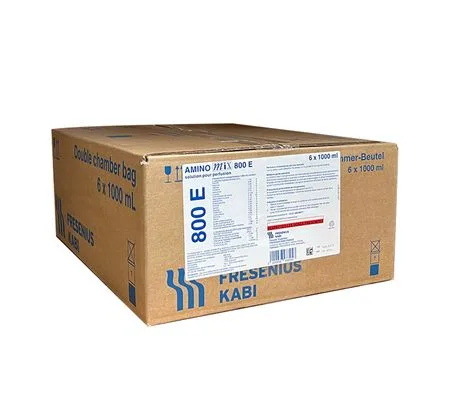
AMINOMIX 800 E, solution for infusion
Composition
AMINOMIX 800 E consists of an amino acid solution and a carbohydrate solution, combined with electrolytes, packaged in a two-chamber bag, in a volume ratio of 1:1.
1 000 ml of solution for infusion contain:
|
Amino acid solution |
Glucose solution |
Ready-to-use mixed solution |
|
|
Active substances |
500 ml |
500 ml |
1 000 ml |
|
Isoleucine |
2,50 g |
2,50 g |
|
|
Leucine |
3,70 g |
3,70 g |
|
|
Lysine hydrochloride |
4,125 g |
4,125 g |
|
|
Equivalent to lysine |
3,30 g |
3,30 g |
|
|
Methionine |
2,15 g |
2,15 g |
|
|
Phenylalanine |
2,55 g |
2,55 g |
|
|
Threonine |
2,20 g |
2,20 g |
|
|
Tryptophan |
1,00 g |
1,00 g |
|
|
Valine |
3,10 g |
3,10 g |
|
|
Arginine |
6,00 g |
6,00 g |
|
|
Histidine |
1,50 g |
1,50 g |
|
|
Glycine |
5,50 g |
5,50 g |
|
|
Serine |
3,25 g |
3,25 g |
|
|
Tyrosine |
0,20 g |
0,20 g |
|
|
Taurine |
0,50 g |
0,50 g |
|
|
Alanine |
7,00 g |
7,00 g |
|
|
Proline |
5,60 g |
5,60 g |
|
|
Sodium glycerophosphate hydrate |
4,59 g |
4,59 g |
|
|
Glacial acetic acid |
4,50 g |
4,50 g |
|
|
Potassium hydroxide |
1,981 g |
1,981 g |
|
|
Hydrochloric acid 25 % |
1,47 ml |
1,47 ml |
|
|
Glucose monohydrate |
220,0 g |
220,0 g |
|
|
Equivalent to anhydrous glucose |
200,0 g |
200,0 g |
|
|
Sodium chloride |
1,169 g |
1,169 g |
|
|
Calcium chloride dihydrate |
0,294 g |
0,294 g |
|
|
Magnesium chloride hexahydrate |
0,61 g |
0,61 g |
|
|
Zinc chloride |
0,00545 g |
0,00545 g |
Electrolytes:
Na+ ........................................................................................................................................................................................................................50 mmol/l
K+ ..............................................................................................................................................30 mmol/l
Ca++.............................................................................................................................................2 mmol/l
Mg++ ............................................................................................................................................3 mmol/l
Zn++ ............................................................................................................................................0,04 mmol/l
Cl-..............................................................................................................................................64 mmol/l
Acetate- .....................................................................................................................................75 mmol/l
Glycerophosphate- -....................................................................................................................15 mmol/l
Reconstituted solution:
Total amino acids.........................................................................................................................50 g
Total nitrogen content..........................................................................................................................8 g
Non-protein energy .................................................................................................................800 kcal
Total energy content ............................................................................................................1 000 kcal
Osmolality .................................................................................................................1 826-2 018 mosm/kg
Osmolarity............................................................................................................................1 779 mosm/l
Titratable acidity (after mixing) ...........................................................................18,0-33,0 mmol NaOH/l
pH (after mixing).......................................................................................................................5,5-6,0
Water for injectable preparations, sodium hydroxide (pH adjustment), hydrochloric acid (pH adjustment).
Indications
AMINOMIX 800 E is indicated to meet the daily requirements for nitrogen (amino acids), glucose, electrolytes and fluid needs of adults and children over 2 years, requiring parenteral nutrition (i.e. when oral or enteral nutrition is impossible, insufficient or contraindicated).
Dosage and administration
Dosage
INTRAVENOUS INFUSION VIA CENTRAL VEIN.
The dosage depends on the requirements for amino acids, carbohydrates, electrolytes and fluid needs and depends on the clinical condition of the patient (nutritional status and severity of the catabolism caused by the metabolic disorder).
In case of additional energy requirements, it is recommended to administer lipid emulsions. Start the infusion at a rate below the desired rate then increase to the recommended rate over a period of 2-3 days.
Adults (including elderly subjects) and adolescents over 14 years
Follow the medical prescription.
The recommended dosage is 20 mL per kg of body weight per day, corresponding to:
- 1 g of amino acids and 4 g of glucose per kg of body weight per day
- 1 400 mL per day for a patient weighing 70 kg
Maximum infusion rate: 1,25 mL per kg of body weight per hour, which corresponds to 0,06 g of amino acids and 0,25 g of glucose per kg of body weight per hour.
Maximum daily dosage: 30 mL per kg of body weight, which corresponds to:
- 1,5 g of amino acids and 6 g of glucose per kg of body weight,
- 2 100 mL for a patient weighing 70 kg,
- 105 g of amino acids and 420 g of glucose for a patient weighing 70 kg.
The general principles of use and dosage for carbohydrates, as well as the general recommendations for fluid requirements, must be taken into account.
Under normal metabolic conditions, the total daily carbohydrate intake must be limited to 300-400 g. This limit corresponds to the maximum oxidation capacity. If this dosage is exceeded, hepatic adverse effects may occur. Under impaired metabolic conditions (post-trauma, hypoxia, organ insufficiency), the daily carbohydrate dose will be reduced to 200-300 g (equivalent to 3 g per kg of body weight); individual adjustment of the dosage requires adequate patient monitoring.
The following restrictions for glucose must be strictly observed in adults: 0,25 g per kg of body weight per hour and up to 6 g per kg of body weight per day.
When administering carbohydrate solutions, regardless of concentration, blood level monitoring is strongly recommended. To avoid overdosage, particularly when using highly concentrated solutions, pump infusion is recommended.
Children and adolescents under 14 years
The recommended dosage in children is only a guideline based on average values. The dosage must be individually adjusted according to the child's age, development, and the presence of any underlying disorder.
Daily dose in children aged 2 to 5 years: 25 mL per kg of body weight, which corresponds to 1,25 g of amino acids and 5 g of glucose per kg of body weight per day.
Daily dose in children aged 5 to 14 years: 20 mL per kg of body weight, which corresponds to 1 g of amino acids and 4 g of glucose per kg of body weight per day.
Maximum infusion rate: 1,25 mL per kg of body weight per hour, which corresponds to 0,06 g of amino acids and 0,25 g of glucose per kg of body weight per hour.
No clinical study confirming the safety, tolerability, and efficacy of the AMINOMIX 800E solution has been conducted in children or adolescents.
Duration of treatment
Only for short- and medium-term parenteral nutrition, if AMINOMIX 800 E is the only parenteral nutrition solution administered at the recommended dosage, depending on the patient's general condition and the extent of catabolism. However, supplementary intake of lipids, vitamins, and trace elements must be considered from the start of treatment.
The solution may also be administered for the same therapeutic indications when oral or enteral nutrition is insufficient or impossible for a longer period, provided that an adequate intake of lipids, vitamins, and trace elements is ensured
Contraindications
AMINOMIX 800 E is contraindicated in the following cases:
- congenital disorders of amino acid metabolism,
- severe hepatic insufficiency,
- severe renal insufficiency, in the absence of haemodialysis, haemofiltration, or haemodiafiltration,
- hyperkalaemia, hypernatraemia,
- unstable metabolism (e.g., severe catabolism, unstable diabetes, undefined comatose state),
- severe hyperglycaemia due to insulin resistance, with poor glucose tolerance despite administration of large amounts of insulin,
- Hypersensitivity to the active substances or to any of the excipients listed in section Composition.
General contraindications for parenteral nutrition:
- circulatory instability threatening vital prognosis (collapse and shock),
- cellular hypoxia or metabolic acidosis,
- hyperhydration/circulatory overload and/or acute pulmonary edema,
- decompensated heart failure/congestive heart failure.
Pre-existing hyponatremia must be corrected before the start of treatment.
Due to its composition (amino acids), AMINOMIX 800 E is contraindicated in newborns and children under 2 years of age.
Warnings and precautions
If the infusion is administered over a period of less than 24 hours, the infusion rate must be gradually increased during the first 1year hour and gradually decreased during the last hour, to avoid abrupt variations in blood glucose.
Individual dose adjustment is recommended in patients with hepatic, renal, adrenal, cardiac or pulmonary insufficiency.
Throughout the duration of treatment, blood glucose, electrolytes, acid-base balance, fluid balance and blood count must be regularly monitored.
In case of a significant increase in blood glucose, the infusion must be interrupted and glycemic peaks must be treated if necessary.
In particular, regular clinical and biological monitoring is necessary in patients with:
- disorders of amino acid metabolism,
- hepatic insufficiency (taking into account the risks of neurological disorders or worsening of pre-existing neurological disorders related to hyperammonemia),
- renal insufficiency, in particular in cases of pre-existing hyperkalemia, if there are risks of onset or worsening of metabolic acidosis and hyperazotemia resulting from impaired renal clearance,
- diabetes (blood glucose, glycosuria, ketonuria, insulin assay),
- lactic acidosis and hyperosmolarity.
In case of long-term use (several weeks), blood count and coagulation factors must be monitored.
Paediatric population
The dosage must be adjusted according to age, nutritional status and the presence of an underlying disorder and, if necessary, oral or parenteral protein supplementation will be administered.
For administration to children over 2 years of age, it is essential to use a container that allows delivery of the equivalent of the required daily dosage in a single container.
In addition, it is important that treatment be supplemented with preparations providing energy, vitamins and trace elements. Pediatric formulations should be used for this supplementation.
Fertility, pregnancy and breastfeeding
No clinical data regarding the administration of AMINOMIX 800 E to pregnant women and during breastfeeding are available. Animal studies to evaluate the reproductive toxicity of AMINOMIX 800 E have not been performed. It is therefore preferable not to administer AMINOMIX 800 E during pregnancy or breastfeeding.
However, if administration of AMINOMIX 800 E is absolutely necessary, after assessment of the benefit/risk ratio, AMINOMIX should be administered with caution during pregnancy and breastfeeding.
Adverse effects
No adverse effects of AMINOMIX 800 E are known when properly administered.
However, adverse effects, which are not specifically related to the product but to parenteral nutrition in general, may occur, particularly at the beginning of treatment:
|
Common |
Uncommon |
Rare |
|
|
(≥ 1/100 to 1 < 1/0) |
(≥ 1/1 000 to 1 < 1/100) |
(≥ 1/10 000 to < 1/1 000) |
|
|
Gastrointestinal disorders |
Nausea, vomiting |
||
|
General disorders and administration site conditions |
Headache, chills, fever |
Reporting of suspected adverse reactions
Reporting suspected adverse reactions after authorisation of the medicinal product is important. It allows continued monitoring of the benefit/risk balance of the medicinal product. Healthcare professionals are asked to report any suspected adverse reactions via the national reporting system: National Agency for the Safety of Medicines and Health Products (ANSM) and the network of Regional Pharmacovigilance Centres - Website: www.ansm.sante.fr.
Overdose
In case of incorrect administration (dosage or flow rate), signs of hyperglycaemia, hyperhydration and hyperosmolarity as well as disturbances of the acid-base balance and of the electrolyte balance may be observed.
As with other solutions containing amino acids, an infusion that is too rapid may also cause chills, nausea, vomiting and an increase in urinary amino acid loss. If these manifestations occur, the infusion must be stopped immediately or continued at a lower flow rate, depending on the most appropriate approach.
In case of hyperkalaemia, infusion of 200 to 500 ml of 10 % glucose solution with addition of 1 to 3 IU of unmodified insulin per 3-5 g of glucose is recommended. If all attempts fail, administration of a potassium-chelating cation exchanger may be indicated. Dialysis is unavoidable in extreme cases.
Pharmacodynamics
Pharmacotherapeutic class: Solutions for parenteral nutrition, ATC code: B05BA10.
Like amino acids derived from the ingestion and assimilation of dietary proteins, those administered parenterally enter the free amino acid pool as well as all subsequent metabolic pathways.
AMINOMIX 800 E contains all essential amino acids and various non-essential amino acids in a proportion similar to that present in other standard amino acid solutions. They are used for endogenous protein synthesis. In addition, certain amino acids exert particular physiological functions.
Glucose is metabolised as an energy carrier by almost all tissues. It enters the glycolysis cycle after phosphorylation. The metabolism of glucose as an energy substrate or as a precursor for endogenous synthesis is well documented.
Electrolytes are essential nutrients for maintaining and correcting fluid and electrolyte homeostasis.
Zinc is a trace element that performs various physiological functions and plays a particular role in wound healing and immune defence in the majority of malnourished patients.
Pharmacokinetics
Absorption
The bioavailability of AMINOMIX 800 E is 100 %.
Distribution
Amino acids enter the plasma pool of the corresponding amino acids, distributing as needed into the interstitial fluid and the intracellular compartment of the various tissues, where they undergo metabolic reactions such as protein synthesis and oxidation. Nitrogen may be used for the synthesis of non-essential amino acids or eliminated in the form of urea.
Plasma and intracellular amino acid concentrations are regulated endogenously within narrow limits depending on the patient's pathological condition. Balanced amino acid solutions such as AMINOMIX 800 E do not significantly alter the amino acid profile when infused at a constant low flow rate.
In healthy subjects, insulin keeps blood glucose within normal limits, which facilitates the passage of glucose across cell membranes and other homeostatic mechanisms. Glucose tolerance is often reduced in patients who require parenteral nutrition, making the administration of insulin necessary.
The distribution of electrolytes is regulated according to the intra- and extracellular concentrations of each ion.
Elimination
Only a small proportion of the infused amino acids is eliminated by the kidneys. For the majority of amino acids, plasma half-lives of 10 to 30 minutes have been reported. In certain pathological situations, glucose may be eliminated renally when the maximum tubular reabsorption capacity is exceeded. Elimination of electrolytes depends on individual requirements, the metabolic situation and the renal function of the patient.
Preclinical safety
AMINOMIX 800 E has not been the subject of preclinical studies. However, no toxicity of the product is expected at the recommended doses.
INCOMPATIBILITIES
Incompatibilities may occur following the addition of polyvalent cations, for example calcium, particularly when combined with heparin. Do not add inorganic phosphate due to the risk of precipitation of calcium and magnesium phosphate.
For reasons of microbiological safety and risk of incompatibility, AMINOMIX 800 E must not be mixed with other medicinal products. AMINOMIX 800 E may be mixed aseptically with other nutrients, for example lipids, additional electrolytes, trace elements and vitamins. Care must be taken to ensure adequate mixing and particularly to avoid any incompatibility.
The product may be stored based on the stability data provided by the manufacturer, but only if the mixture has been prepared under controlled and validated aseptic conditions.
No substance should be added to the infusion system without prior verification of compatibility.
Shelf life
Shelf life of the product in its commercial packaging
2 years.
Shelf life after reconstitution in accordance with the instructions
It has been demonstrated that the mixture of the solutions from the 2 chambers is chemically and physically stable for 24 hours at a temperature of 25 °C. From a microbiological point of view, the product should be used immediately when the tubing is connected to the bag. If use is not immediate, the storage time and conditions before use are the responsibility of the user.
Special storage precautions
Store at a temperature not exceeding 25 °C. Store in the overpouch.
Keep the bag in the outer packaging (carton) to protect from light.
For microbiological safety reasons, the mixture should be used immediately after addition of additives. If use is not immediate, the storage time and conditions before administration are the responsibility of the user. The reconstituted solution should not normally be stored for more than 24 hours at 4-8 °C, unless additions have been made under controlled and validated aseptic conditions.
Data on the chemical and physical stability of several "all-in-one" preparations stored at 4 °C for periods of up to 7 days are available on request from the manufacturer.
SPECIAL PRECAUTIONS FOR DISPOSAL AND OTHER HANDLING
The two solutions contained in the bag must be mixed immediately before administration.
Instructions for handling
1. Remove the outer packaging and place the bag on a firm surface.
2. Roll the bag gently on itself starting from the handle and press until the vertical seal breaks. Mix thoroughly.
Administer only if the amino acid solution and the glucose solution are clear and if the containers are not damaged.
Use immediately after opening the pack. Any unused solution must be discarded.
Lipids, electrolytes, trace elements and vitamins may be added, under aseptic conditions, to AMINOMIX 800E. Particular attention should be paid to mixing the bag and to compatibility with the added solutions.
Any unused medicinal product or waste material should be disposed of in accordance with local requirements.
Prescription, supply and reimbursement
| Marketing authorisation (AMM) |
|
| Price: |
|
Collection.
5 PLACE DU MARIVEL
92316 SEVRES
Tel: 01 41 14 26 00 internet.fkf@fresenius-kabi.com
http://www.fresenius-kabi.fr/
Source: VIDAL · Updated on 10/11/2026. This information does not replace advice from a healthcare professional.