
Medicines
RCP of 23/10/2017
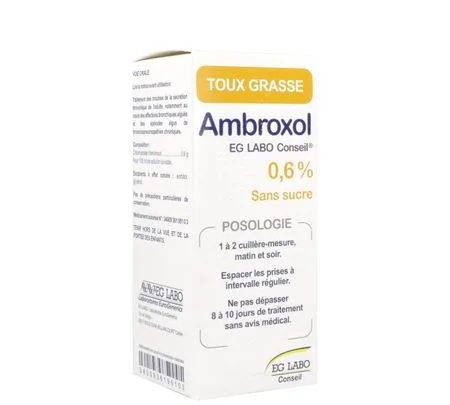
AMBROXOL EG LABO CONSEIL 0,6 %, oral solution
Composition
Ambroxol hydrochloride................................................................................................................................0,6 g
For 100 mL of oral solution.
Excipients with known effect: sorbitol, glycerol.
Glycerol, citric acid monohydrate, methyl parahydroxybenzoate (E218), propyl parahydroxybenzoate (E216), banana flavouring, liquid sorbitol (non-crystallisable), purified water.
Indications
Treatment of disorders of bronchial secretion in adults, particularly in the course of acute bronchial conditions and acute episodes of chronic bronchopneumopathies.
Dosage and administration
Dosage
RESERVED FOR ADULTS.
5 ml of oral solution contains 30 mg of ambroxol hydrochloride.
The average dosage of ambroxol hydrochloride is 60 to 120 mg per day divided into 2 doses, i.e. 5 to 10 ml 2 times per day (morning and evening).
A dosing cup graduated at 2,5 ml, 5 ml, 7,5 ml, 10 ml and 15 ml or a 5 ml measuring spoon are provided to allow measurement of the quantity of active ingredient for one dose:
That is 5 ml to 10 ml from the dosing cup or 1 to 2 measuring spoons.
Contraindications
Hypersensitivity to the active substance or to any of the excipients listed in section Composition.
Warnings and precautions
Cases of severe skin reactions such as erythema multiforme, Stevens-Johnson syndrome (SJS)/Lyell syndrome and acute generalised exanthematous pustulosis (AGEP) associated with administration of ambroxol hydrochloride have been reported. If signs or symptoms of a progressive skin eruption (sometimes associated with blisters or mucosal lesions) are present, treatment with ambroxol hydrochloride must be stopped immediately and a doctor must be consulted.
The combination of a bronchial mucomodifier with an antitussive and/or secretion-drying substances (anticholinergics) is irrational.
This medicine contains sorbitol. Its use is not recommended in patients with fructose intolerance (a rare hereditary disease).
This medicine contains glycerol and may cause digestive disorders and a mild laxative effect (diarrhoea).
Fertility, pregnancy and breastfeeding
Pregnancy
Animal studies have not revealed any teratogenic effect. In the absence of a teratogenic effect in animals, a malformative effect in the human species is not expected.
Indeed, to date, substances responsible for malformations in the human species have been shown to be teratogenic in animals in well-conducted studies in two species.
In clinical practice, there are currently no sufficiently relevant data to assess a possible malformative or foetotoxic effect of ambroxol hydrochloride when administered during pregnancy.
Consequently, as a precaution, it is preferable not to use ambroxol hydrochloride during pregnancy.
Breast-feeding
During breastfeeding, the use of this product is not recommended.
Adverse effects
Immune system disorders
Rare: hypersensitivity reactions
Frequency not determined: anaphylactic reactions, including anaphylactic shock, angioedema and pruritus
Skin and subcutaneous tissue disorders
Rare: skin eruption, urticaria
Frequency undetermined: severe skin reactions (including erythema multiforme, Stevens-Johnson syndrome/Lyell syndrome and acute generalised exanthematous pustulosis)
In these cases treatment must be discontinued without delay.
Gastrointestinal system disorders:
Uncommon: gastrointestinal disorders such as nausea, vomiting, gastralgia, heartburn, dyspepsia.
Nervous system disorders:
Very rare: headache, dizziness.
Due to the presence of sorbitol, possibility of digestive disorders and diarrhoea.
Reporting of suspected adverse reactions
Reporting suspected adverse reactions after authorisation of the medicinal product is important. It allows continued monitoring of the benefit/risk balance of the medicinal product. Healthcare professionals are asked to report any suspected adverse reaction via the national reporting system: National Agency for the Safety of Medicines and Health Products (ANSM) and the network of Regional Centres of Pharmacovigilance - Website: www.ansm.sante.fr.
Pharmacodynamics
Pharmacotherapeutic class: Mucolytics, ATC code: R05CB06.
Ambroxol possesses mucokinetic and expectorant properties.
By its action on secretory cells, it stimulates bronchial secretion and promotes the production of a more easily mobilised mucus. It increases ciliary activity
Pharmacokinetics
Absorption
After oral administration, ambroxol is rapidly and well absorbed from the gastrointestinal tract
Distribution
Given the hepatic first-pass effect, bioavailability is approximately 70%.
The peak plasma concentration is reached in approximately 2 hours.
The increase in concentrations is proportional to the dose.
At therapeutic doses, binding to plasma proteins is approximately 90%.
High values of volumes of distribution indicate significant extravascular diffusion, particularly into the lungs.
Biotransformation
The metabolism of ambroxol partly involves CYP3A4.
It is not necessary to adjust the dosage in elderly subjects and patients with hepatic impairment. There are no data in patients with renal impairment.
Elimination
The elimination half-life is between 7 and 12 hours. No accumulation of the product was observed after repeated administration.
Elimination is mainly urinary (83% of the dose) with two main metabolites excreted in glucuronide-conjugated form.
Prescription, supply and reimbursement
| Marketing authorisation (AMM) |
|
CENTRAL PARK 9-15 RUE MAURICE MALLET
92130 ISSY-LES-MOULINEAUX
Tel: 01 46 94 86 86 contact@eglabo.fr
https://www.eglabo.fr/
Source: VIDAL · Updated on 10/11/2026. This information does not replace advice from a healthcare professional.