
Medicines
SmPC of the 19/10/2026
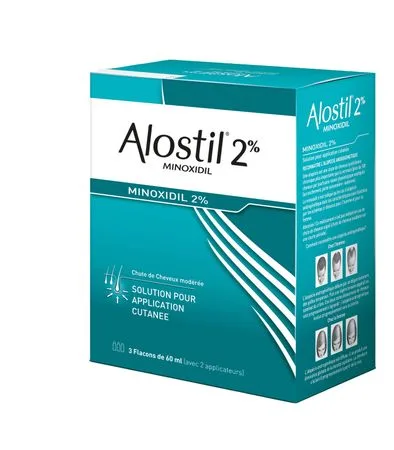
ALOSTIL 2 %, solution for cutaneous application
Composition
Minoxidil ....................................................................................................................................... 2,0 g
For 100 ml of solution for cutaneous application
Excipients with known effect:
Each ml of solution contains 208 mg of propylene glycol and 473,4 mg of ethanol at 96 %.
Propylene glycol, ethanol at 96 %, purified water.
Indications
This medicine is indicated for moderate hair loss (androgenetic alopecia) in adults, men or women. It promotes hair growth and stabilises hair loss.
Dosage and administration
RESERVED FOR ADULTS over 18 years
Dosage
Apply 2 times per day (once in the morning and once in the evening) a dose of 1 ml to the bald area of the scalp, starting from the centre of the area to be treated.
The daily dose must not exceed 2 ml.
Method of administration
Cutaneous use.
Spread the product with the fingertips so as to cover the entire area to be treated (see application method according to the delivery system).
Before and after applying the solution, wash hands thoroughly.
Apply to perfectly dry hair and scalp.
The application method varies depending on the delivery system used with the bottle.
Spray pump : this system is suitable for application over large surfaces.
1. Unscrew and remove the inner cap fitted with a child safety device.
2. Insert the spray pump into the bottle, screw it on firmly and remove the small transparent cap.
3. For application: direct the spray pump towards the centre of the surface to be treated, press once and spread the product with the fingertips. Repeat the operation 6 times to apply a dose of 1 ml.
Avoid inhaling the product.
After application, remove the spray pump, rinse it and screw the cap with the child safety device back onto the bottle.
Spray pump fitted with an applicator : this system is suitable for application over small surfaces or under the hair.
1. Unscrew and remove the inner cap fitted with a child safety device.
2. Insert the spray pump into the bottle, screw it on firmly and remove the small transparent cap.
3. Pull firmly upwards to remove the "head" (bearing an arrow) from the spray pump.
4. Insert the applicator onto the spray pump stem (now without its head) and push fully. Finally, remove the cap (transparent plastic) from the end of the applicator.
5. For application: direct the spray pump towards the centre of the area to be treated or under the hair, press once and spread the product with the fingertips. Repeat the operation 6 times to apply a dose of 1 ml.
Avoid inhaling the product.
After application, remove the applicator and the spray pump, rinse them and screw the child-safety cap back onto the bottle.
Duration of use
Results may not be visible before 3 to 4 months of treatment applied twice daily. Do not continue using ALOSTIL if there is no improvement after 4 months of application.
Contraindications
Hypersensitivity to the active substance or to any of the excipients listed in section Composition.
Warnings and precautions
Before using topical minoxidil, the subject must ensure that their scalp is normal and healthy.
It must not be applied if the scalp skin is inflamed, infected, irritated or painful.
Increased percutaneous absorption of minoxidil, which may cause systemic effects, is possible in cases of:
• dermatosis or lesion of the scalp,
• concomitant application of retinoic acid, anthralin or any other irritant topical product,
• increase in the applied dose and/or increase in the frequency of applications: it is imperative to comply with the dosage and the method of administration.
Likewise, although extensive use of minoxidil solution has not revealed any systemic effects, it cannot be excluded that greater absorption linked to individual variability or unusual sensitivity could cause systemic effects. Patients should be warned of this.
If systemic effects occur (decrease in blood pressure, tachycardia, signs of fluid retention (swelling of the hands or feet), chest pain) or severe dermatological reactions (for example persistent redness or irritation of the scalp), loss of consciousness, dizziness, or sudden and unexplained weight gain or any other unexpected symptom (see section Adverse effects), treatment must be discontinued and the patient must consult a doctor.
Patients with cardiovascular disease or cardiac arrhythmia must consult a doctor before using topical minoxidil. In these subjects, the benefit of treatment must be weighed.
They should be particularly warned of potential undesirable effects so as to discontinue treatment as soon as any of them appears and to inform a doctor.
If symptoms persist or worsen, or if new symptoms appear, patients must discontinue treatment and consult a doctor.
Do not apply minoxidil:
• in case of hair loss occurring in patches and/or abruptly, hair loss following illness, drug treatment, childbirth, or if the cause of alopecia is unknown,
• on any other part of the body,
• at the same time as other medicinal products on the scalp.
Accidental ingestion may lead to severe undesirable effects, in particular cardiac effects (see section Adverse effects). This product must therefore be kept out of the reach of children.
In case of accidental contact with the eye, damaged skin or a mucous membrane, the solution (containing ethanol) may cause a burning sensation and/or irritation: rinse abundantly with cold running water.
Sun exposure is not recommended when applying minoxidil.
Do not inhale.
Using a higher dosage or frequency will not result in improved results.
Continued treatment is necessary to increase and maintain hair regrowth. Otherwise, hair loss will resume.
A temporary increase in hair loss may occur during the first 2 to 6 weeks of treatment.
Unwanted hair growth may occur due to transfer of the product to areas other than the scalp.
This medicine contains 208 mg of propylene glycol per 1 ml dose.
This medicine contains 473,4 mg of alcohol (ethanol) per dose of 1 mL. This may cause a burning sensation on damaged skin. Keep away from any flame, lit cigarette or source of intense heat.
Hypertrichosis in children following accidental topical exposure to minoxidil:
Cases of hypertrichosis have been reported in infants after skin contact at the minoxidil application sites of patients (caregivers) using topical minoxidil. The hypertrichosis was reversible within a few months when the infants were no longer exposed to minoxidil. Contact between children and minoxidil application sites must therefore be avoided.
Interactions
Topical minoxidil must not be used at the same time as other medicines (in particular, corticosteroids, tretinoin, anthralin) on the scalp, as these topical medicines may alter the permeability of the skin and lead to a change in the absorption of minoxidil.
An interaction with guanethidine has been reported with oral formulations of minoxidil leading to a rapid and pronounced drop in blood pressure.
Fertility, pregnancy and breastfeeding
Pregnancy
Topical minoxidil must not be used during pregnancy.
No adequate or well-controlled studies have been conducted in pregnant women. Animal studies have shown a risk to the foetus at very high exposure levels compared with the exposure anticipated in humans. A low, although unlikely, risk of foetal harm is possible in humans (see section Preclinical safety, Preclinical safety data).
Breast-feeding
When administered systemically, minoxidil passes into breast milk; consequently the medicine must not be used in breastfeeding women.
Fertility
No adequate or well-controlled studies have been conducted regarding fertility in women.
Studies conducted in animals have shown toxicity to fertility, a decrease in conception and implantation rates and a reduction in the number of live births at exposure levels far exceeding those anticipated in humans (see section Preclinical safety). The potential risk for humans is not known.
Driving and using machines
Minoxidil may cause dizziness or hypotension (see section Adverse effects). Patients should exercise caution if they drive or use machines.
Adverse effects
The safety of topical minoxidil is based on 7 randomised, placebo-controlled clinical studies in adults evaluating minoxidil in solution at 2% or 5%, and two randomised, placebo-controlled clinical studies in adults evaluating the foam formulation at 5%.
The adverse reactions identified during clinical studies and after marketing authorisation are presented in the table below. In this table, frequencies are presented according to the following convention:
Very common ≥ 1/10
Common ≥ 1/100 and < 1/10
Uncommon ≥ 1/1 000 and < 1/100
Rare ≥ 1/10 000 and < 1/1 000
Very rare < 1/10 000
Not known (frequency cannot be estimated from the available data)
Adverse reactions are presented by frequency category based on 1) the incidence in clinical trials or epidemiological studies, if available, or 2) when the incidence cannot be estimated, the frequency category is listed as "not known"
|
System organ class |
|
|
Frequency category |
Recommended term for the adverse reaction |
|
Infections and Infestations |
|
|
Frequency not known |
Otitis externa |
|
Immune system disorders |
|
|
Frequency not known
|
Allergic contact dermatitis |
|
Allergic reactions, including angioedema (manifestations of angioedema may include the following recommended terms: lip oedema, lip swelling, oral oedema, oropharyngeal swelling, pharyngeal oedema, tongue swelling and tongue oedema) |
|
|
Hypersensitivity (manifestations of hypersensitivity reactions may include the following recommended MedDRA dictionary terms: facial oedema, generalised erythema, generalised pruritus, sensitivity, rhinitis, paraesthesia, facial swelling and throat constriction) |
|
|
Nervous system disorders |
|
|
Uncommon |
Dizziness sensations |
|
Very common |
Headache |
|
Frequency not known |
Dysgeusia |
|
Neuritis |
|
|
Paresthesia |
|
|
Eye disorders |
|
|
Frequency not known |
Eye irritation |
|
Visual disorders |
|
|
Cardiac disorders |
|
|
Rare |
Chest pain |
|
Acceleration of heart rate (tachycardia) |
|
|
Palpitations |
|
|
Vascular disorders |
|
|
Frequency not known |
Hypotension |
|
Respiratory, thoracic and mediastinal disorders |
|
|
Common |
Dyspnoea |
|
Gastrointestinal disorders |
|
|
Uncommon |
Nausea |
|
Frequency not known |
Vomiting |
|
Hepatobiliary disorders |
|
|
Frequency not known |
Change in hepatic function |
|
Skin and subcutaneous tissue disorders |
|
|
Common |
Dermatitis, acneiform dermatitis |
|
Hypertrichosis (affecting parts other than the scalp) |
|
|
Pruritus |
|
|
Rash |
|
|
Frequency not known |
Alopecia |
|
Change in hair colour |
|
|
Abnormal hair growth |
|
|
Abnormal hair texture |
|
|
General disorders and administration site conditions |
|
|
Common |
Peripheral oedema |
|
Frequency not known |
Administration site reactions: these sometimes affect surrounding structures, particularly the ears and face, and generally manifest as pruritus, irritation, pain, burning sensation, skin rash, acne, oedema, dry skin and erythema, but may sometimes be more severe and include: exfoliation, dermatitis, vesiculation, bleeding and ulceration. |
|
Asthenia |
|
|
Investigations |
|
|
Common |
Weight gain* |
* this adverse event was observed during clinical studies of minoxidil foam.
Reporting of suspected adverse reactions
Reporting suspected adverse reactions after authorisation of the medicinal product is important. It allows continued monitoring of the benefit/risk balance of the medicinal product. Healthcare professionals are asked to report any suspected adverse reaction via the national reporting system: National Agency for the Safety of Medicines and Health Products (ANSM) and the network of Regional Centres of Pharmacovigilance - Website: https://signalement.social-sante.gouv.fr/.
Overdose
An increase in systemic absorption of minoxidil that may lead to adverse events may occur if doses higher than the recommended dosage are applied to larger body areas or areas other than the scalp.
Accidental ingestion may cause systemic effects due to the vasodilator action of minoxidil (5 ml of solution contain 100 mg of minoxidil, i.e. the maximum dose used for oral administration in adults treated for arterial hypertension). The signs and symptoms of a possible overdose would be cardiovascular, with hypotension, tachycardia, lethargy and fluid and sodium retention. Fluid and sodium retention may be treated with appropriate diuretic therapy, tachycardia and angina with a beta-blocking agent or another sympathetic nervous system inhibitor. Symptomatic hypotension could be treated by intravenous administration of isotonic sodium chloride solution. The use of sympathomimetics, such as noradrenaline and adrenaline, should be avoided due to excessive cardiac stimulation.
Keep out of the reach of children. In case of ingestion, contact a doctor or an emergency service immediately.
Pharmacodynamics
Pharmacotherapeutic class: MINOXIDIL FOR TOPICAL USE (D: dermatological drugs), ATC code: D11AX01.
Mechanism of action
The precise mechanism of action is not known, but certain effects of minoxidil include stimulation and prolongation of the anagen growth phase, and stimulation of the transition of hair follicles from the resting (telogen) phase to the growth (anagen) phase.
Clinical efficacy and safety
The efficacy and tolerability in subjects younger than 18 years and older than 65 years have not been studied.
Applied topically, minoxidil stimulates keratinocyte growth in vitro and in vivo and hair growth in some subjects with androgenetic alopecia.
This effect appears after approximately 2 to 4 months (or longer) of product use and varies between subjects.
On discontinuation of treatment, regrowth stops and a return to the initial state is expected within 3 or 4 months.
Topical application of minoxidil in controlled clinical trials in normotensive or hypertensive patients did not give rise to the observation of systemic manifestations related to absorption of minoxidil.
Pharmacokinetics
Absorption
Minoxidil, when applied topically, is only weakly absorbed: an average quantity of 1,4% (for values ranging from 0,3 to 4,5%) of the applied dose reaches the general circulation. Thus for a dose of 1 ml of solution at 2% (i.e. application to the skin of 20 mg of minoxidil), the quantity of minoxidil absorbed corresponds to approximately 0,28 mg.
By comparison, when administered orally (in the treatment of certain hypertensions), minoxidil is almost completely absorbed from the gastrointestinal tract. In one study, the area under the curve (AUC) of minoxidil as a 2% solution averaged 7,54 ng·h/ml, compared with a mean AUC of 35,1 ng·h/ml for the 2,5 mg oral formulation. The mean maximum serum concentration (Cmax) for the topical solution was 1,25 ng/ml, compared with 18,5 ng/ml following administration of an oral dose of 2,5 mg.
The AUC of 5% minoxidil foam used once daily was similar to that of a 2% minoxidil solution used twice daily in female subjects.
Distribution
The volume of distribution of minoxidil after intravenous administration was estimated at 70 litres.
Biotransformation
The biotransformation of minoxidil absorbed after topical application is not fully known.
Approximately 60% of minoxidil absorbed after topical application is metabolised to minoxidil glucuronide, mainly in the liver.
Elimination
The mean half-life of topical minoxidil averages 22 hours. Minoxidil and its metabolites are excreted 97% in urine and 3% in faeces.
After discontinuation of topical application, approximately 95% of absorbed minoxidil is eliminated within 4 days.
Preclinical safety
Preclinical data from conventional safety pharmacology, repeated-dose toxicity, genotoxicity and carcinogenicity studies did not reveal any particular risk for humans.
Specific cardiac effects in dogs were observed at low doses, leading to significant haemodynamic effects associated with cardiac changes in repeated-dose toxicity studies. The available data did not show similar effects in humans treated with minoxidil, orally or cutaneously.
Mutagenic potential
Minoxidil showed no signs of mutagenic or genotoxic potential in a number of in vitro and in vivo assays.
Carcinogenicity
A high incidence of hormone-dependent tumours was observed in mice and rats. These tumours are due to secondary hormonal effects (hyperprolactinaemia) observed only in rodents at extremely high doses, occurring through a mechanism similar to that observed with reserpine.
Topical application of minoxidil did not cause effects on hormonal status in women. Consequently, the tendency of minoxidil to promote hormone-mediated tumours does not constitute a carcinogenic risk in humans.
Teratogenicity
Animal reproductive toxicity studies (rat and rabbit) showed signs of maternal toxicity and a risk to the foetus at exposure levels very high compared with those expected in humans.
Fertility
Doses of minoxidil above 9 mg/kg (at least 25 times the human exposure) administered subcutaneously to rats were associated with reduced fertilisation and implantation rates, as well as a reduced number of live offspring.
SPECIAL PRECAUTIONS FOR DISPOSAL AND OTHER HANDLING
No special requirements.
Any unused medicinal product or waste must be disposed of in accordance with local regulations in force
INSTRUCTIONS FOR THE PREPARATION OF RADIOPHARMACEUTICALS
Detailed information on this medicinal product is available on the ANSM website.
Prescription, supply and reimbursement
| Marketing authorisation (AMM) |
|
41 RUE CAMILLE DESMOULINS
92130 ISSY-LES-MOULINEAUX CEDEX 9
Tel: 00 800 555 22 000 https://www.kenvuecontact.com/
Source: VIDAL · Updated on 10/11/2026. This information does not replace advice from a healthcare professional.