
Medicines
SmPC of the 16/03/2026
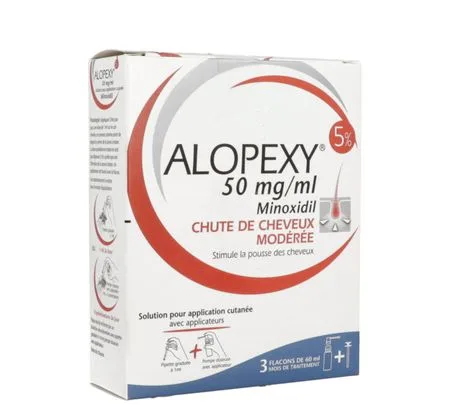
ALOPEXY 50 mg/ml, solution for cutaneous application
Composition
Minoxidil..........................................................................................................................................................50 mg
For 1 ml.
Excipient with known effect: propylene glycol (E1520) 240 mg, ethanol at 96% 520 mg.
Propylene glycol (E1520), ethanol at 96%, purified water.
Indications
ALOPEXY 50 mg/ml, solution for cutaneous application is indicated in adult men for moderate hair loss (androgenetic alopecia).
Note: This medicine is not indicated in women due to its low efficacy and the high frequency of hypertrichosis (37% of cases) at sites distant from the application sites.
Dosage and administration
Dosage
Apply 2 times per day a dose of 1 ml to the scalp, starting from the centre of the area to be treated. This dose must be respected regardless of the extent of the area concerned..
The daily dose must not exceed 2 ml.
Duration of use
Continuous treatment is necessary to increase and maintain hair regrowth. The first results may appear after 2 to 4 months of twice-daily application. The time and degree of response vary from patient to patient. If no improvement in symptoms is observed after 4 months of treatment, patients should stop using ALOPEXY.
A temporary increase in hair loss may occur during the first 2 to 6 weeks of treatment. If hair loss persists beyond 6 weeks, the patient should stop using ALOPEXY and consult their doctor (see section Warnings and precautions).
The onset and degree of response are variable from patient to patient. However, some data suggest that younger users whose baldness began more recently or whose baldness on the crown of the head is less extensive respond better to treatment. Individual responses to treatment are not predictable.
According to some observations, a return to the initial state would occur in 3 or 4 months if treatment is stopped.
Special population
Elderly
ALOPEXY is not recommended in patients over 65 years of age due to the lack of data on safety and efficacy.
Paediatric population
There is no relevant use of minoxidil in the paediatric population for the indication of moderate androgenetic alopecia.
Therefore, the safety and efficacy of ALOPEXY in children under 18 years have not been established. No data are available. Thus, ALOPEXY is not recommended in children under 18 years.
Method of administration
Cutaneous use.
Do not swallow.
Use one of the administration systems (see below) to apply ALOPEXY.
Spread the product with the fingertips so as to cover the entire area to be treated.
Before and after applying the solution, wash hands thoroughly.
Apply to perfectly dry hair and scalp.
Method of application
The child-resistant cap must be removed by pressing down on the cap while turning it counterclockwise (to the left). Only the tamper-evident seal should remain on the bottle.
Depending on the dispensing system used:
Use of the pipette
A pipette allows precise withdrawal of 1 ml of solution to be spread over the entire area to be treated.
Use of the pump with applicator
This system is suitable for application to small areas or under the hair.
Screw the metered-dose pump onto the bottle.
For application: direct the pump towards the centre of the area to be treated, press once and spread the product with the fingertips so as to cover the entire area to be treated. 6 sprays are required to apply a dose of 1 ml.
Rinse the cannula with hot water after each use.
Contraindications
• Hypersensitivity to the active substance or to any of the excipients listed in section Composition.
• Scalp disorders.
• Poor tolerability of the form at 2 % regardless of the symptomatology.
Warnings and precautions
Warnings
In subjects with a scalp dermatosis, increased percutaneous absorption of minoxidil is possible (see section Contraindications.)
Although the occurrence of systemic effects related to minoxidil has not been observed with use of the solution, the possibility of such effects occurring cannot be excluded.
Patients must be warned of potential adverse effects.
Patients with established cardiovascular disease, hypotension or cardiac arrhythmias must consult a doctor before using topical minoxidil. In these subjects, the benefit of treatment must be assessed. Monitoring must be carried out at the start of treatment and regularly thereafter. They must in particular be informed of potential adverse effects (tachycardia, fluid and sodium retention, or weight gain or other systemic effects), so as to stop treatment as soon as any of them occurs.
For other patients, in case of systemic effects or severe dermatological reactions: they must stop using the product and consult a doctor if hypotension is suspected, in case of chest pain, rapid heart rate, fainting or dizziness, sudden unexplained weight gain, oedema of the hands or feet, or persistent redness or irritation of the scalp.
If hair loss persists or worsens beyond 6 weeks of minoxidil treatment, or if new symptoms appear, patients must interrupt treatment and seek medical advice.
The risk of hypertrichosis at a distance from the application site justifies not using this specialty in women.
Minoxidil must not be applied to any other part of the body.
Minoxidil is not indicated in the absence of a family history of alopecia, in cases of sudden and/or patchy hair loss, hair loss following childbirth, or hair loss due to an unknown cause.
Hypertrichosis in children following unintentional topical exposure to minoxidil:
Cases of hypertrichosis have been reported in infants after skin contact at the minoxidil application sites of patients (caregivers) using topical minoxidil. The hypertrichosis was reversible within a few months when the infants were no longer exposed to minoxidil. Contact between children and minoxidil application sites must therefore be avoided.
Precautions for use
Minoxidil should only be used on a normal, healthy scalp. It must not be used if the scalp shows redness, inflammation, infection or irritation, or is painful, or if other treatments are being applied to the scalp.
Continuous treatment is necessary to increase and maintain hair regrowth. A temporary increase in hair loss may occur during the first 2 to 6 weeks of treatment. If hair loss persists beyond 6 weeks, the patient must stop using minoxidil and consult their doctor (see section Dosage and administration).
In case of contact with the eye, the medicine (containing ethanol) may cause a burning sensation and irritation. In case of accidental contact with sensitive surfaces (eye, wounds, damaged skin and mucous membranes), the affected area must be washed thoroughly with a large quantity of cold running water.
Inhalation of the spray mist must be avoided.
Accidental ingestion may lead to serious adverse cardiac effects (see section Overdose). Therefore, this medicine must be kept out of the reach of children.
This medicine contains 520 mg of alcohol (ethanol) per ml. This may cause a burning sensation on damaged skin.
Patients have noticed a change in the colour and/or texture of their hair.
Sun exposure is not recommended during application of minoxidil.
Interactions
Pharmacokinetic interaction studies in humans have shown that percutaneous absorption of minoxidil is increased by tretinoin and anthralin due to increased permeability of the stratum corneum; betamethasone dipropionate increases local tissue concentrations of minoxidil and decreases its systemic absorption.
Although not clinically proven, the risk of orthostatic hypotension in patients also treated with peripheral vasodilators cannot be excluded.
Topically, the absorption of minoxidil is controlled and limited by the Stratum corneum. Concomitant use of topical medicinal products that affect the barrier formed by the Stratum corneum may lead to an increase in the absorption of the applied minoxidil. Therefore the concomitant use of ALOPEXY and other topical medicines is not recommended.
Fertility, pregnancy and breastfeeding
This medicine is not indicated in women of childbearing potential. It must not be used in women who are pregnant or who might become pregnant, or who are breast-feeding (see section Indications).
Pregnancy
No adequate controlled studies have been conducted in pregnant women. Studies in animals have shown a risk to the foetus at exposure levels sufficiently high relative to those expected for human exposure. There is a low, although unlikely, risk of adverse effects on the foetus in humans (see section Preclinical safety).
ALOPEXY is not recommended during pregnancy and in women of childbearing potential not using contraception.
Breast-feeding
Systemically absorbed minoxidil is excreted in human milk. A risk to newborns/infants cannot be excluded.
ALOPEXY must not be used during breast-feeding.
Fertility
In a fertility study in male and female rats, a dose-dependent reduction in the conception rate was demonstrated (see section Preclinical safety). The potential risk in humans is unknown.
Driving and using machines
ALOPEXY has no or negligible influence on the ability to drive and use machines.
Patients who experience dizziness or hypotension should not drive or use machines (see section Adverse effects).
Adverse effects
The adverse reactions and their frequency were determined from a randomised, double-blind, placebo-controlled clinical study involving 393 patients comparing minoxidil 5% (157 patients) with minoxidil 2% (158 patients) and with a placebo (78 patients).
The frequencies of adverse reactions reported during the marketing of topical minoxidil are unknown.
The adverse reactions and their frequency are listed below by MedDRA system organ class and by frequency. Frequencies are defined using the following classification: Very common (≥ 1/10); common (≥ 1/100 to < 1/10); uncommon (≥ 1/1 000 to < 1/100); rare (≥ 1/10 000 to < 1/1 000), very rare (< 1/10 000), not known (cannot be estimated from the available data).
The most frequently observed reactions consist of minor skin reactions.
Frequent topical application may cause irritation and dryness of the skin, due to the presence of ethanol.
|
System Organ Classes |
Adverse reactions – MedDRA preferred term Frequency |
||
|
Very common |
Common |
Not known |
|
|
Infections and infestations |
|
|
Ear infection Otitis externa Rhinitis |
|
Immune system disorders |
|
|
Hypersensitivity Allergic reactions, including angioedema |
|
Psychiatric disorders |
|
Depression |
|
|
Nervous system disorders |
Headache |
|
Neuritis Tingling sensation Dysgeusia Burning sensation Vertigo |
|
Eye disorders |
|
|
Blurred vision Eye irritation |
|
Cardiac disorders |
|
|
Tachycardia Chest pain Palpitations |
|
Vascular disorders |
|
|
Hypotension |
|
Respiratory, thoracic and mediastinal disorders |
|
Dyspnoea |
|
|
Hepatobiliary disorders |
|
|
Hepatitis |
|
Skin and subcutaneous tissue disorders |
Hypertrichosis (at a distance from the application site) |
Contact dermatitis Pruritus Inflammatory dermatosis Acneiform skin eruption
|
Generalised erythema Alopecia Irregular distribution of hair Changes in hair texture Changes in hair colour
|
|
Musculoskeletal and connective tissue disorders |
|
Musculoskeletal pain |
|
|
Renal and urinary disorders |
|
|
Kidney stones |
|
General disorders and administration site conditions
|
|
Application site reaction: irritation, skin exfoliation, dermatitis, erythema, dryness, pruritus Peripheral oedema Pain |
Facial oedema Oedema Asthenia |
Reporting of suspected adverse reactions
Reporting suspected adverse reactions after authorisation of the medicinal product is important. It allows continued monitoring of the benefit/risk balance of the medicinal product. Healthcare professionals are asked to report any suspected adverse reaction via the national reporting system: National Agency for the Safety of Medicines and Health Products (ANSM) and the network of Regional Centres of Pharmacovigilance - Website: https://signalement.social-sante.gouv.fr/.
Overdose
Signs and symptoms
There is no data indicating that topically applied minoxidil is absorbed in sufficient quantity to cause systemic effects. Overdose is unlikely when the medicinal product is used in accordance with the instructions.
If this medicinal product is applied to an area where the integrity of the skin barrier is reduced due to trauma, inflammation or a skin condition, systemic effects of overdose are possible.
The undesirable effects below, which are very rare, may occur due to the systemic effects of minoxidil:
|
System Organ Classes |
Adverse effects |
|
Nervous system disorders Very rare |
Vertigo |
|
General disorders and administration site conditions Very rare |
Fluid retention leading to weight gain |
|
Cardiac disorders Very rare |
Increased heart rate Hypotension |
Accidental ingestion may cause systemic effects due to the vasodilator action of minoxidil (5 mL of solution contains 250 mg of minoxidil, i.e. 2,5 times the maximum dose used for oral administration in adults treated for arterial hypertension).
Treatment
In case of minoxidil overdose, symptomatic treatment as well as complementary measures must be implemented.
Sodium and water retention may be treated with appropriate diuretic therapy, tachycardia and angina with a beta-blocking agent or another inhibitor of the sympathetic nervous system. Symptomatic hypotension could be treated by intravenous administration of isotonic sodium chloride solution. The use of sympathomimetics such as noradrenaline and adrenaline should be avoided due to excessive cardiac stimulation.
Pharmacodynamics
Pharmacotherapeutic class: OTHER DERMATOLOGICALS,
ATC code: D11AX01.
Mechanism of action
Applied topically, minoxidil stimulates keratinocyte growth in vitro and in vivo and hair regrowth in some subjects with androgenetic alopecia. This phenomenon occurs after approximately 2 months of product use and varies between subjects. On discontinuation of treatment, regrowth ceases and a return to the initial state is expected within 3 or 4 months. The precise mechanism of action is not known.
Clinical efficacy and safety
Topical application of minoxidil in controlled clinical trials in normotensive or untreated hypertensive patients did not give rise to the observation of systemic manifestations related to absorption of minoxidil.
Pharmacokinetics
Absorption
Minoxidil, when applied topically, is only weakly absorbed: an average amount of 1,7% (for values ranging from 0,3 to 4,5%) of the applied dose reaches the systemic circulation.
By comparison, when administered orally in tablet form (in the treatment of certain hypertensions), minoxidil is almost completely absorbed from the gastrointestinal tract. A dose of 1 mL of solution, corresponding to an application on the skin of 50 mg of minoxidil, would therefore result in an absorption of approximately 0,85 mg of minoxidil.
The influence of concomitant dermal conditions on minoxidil absorption has not been determined.
Serum minoxidil levels following topical administration are dependent on the rate of percutaneous absorption.
Biotransformation
The biotransformation of minoxidil absorbed after topical application is not fully known.
Elimination
After discontinuation of topical application, approximately 95% of the absorbed minoxidil is eliminated within 4 days.
Preclinical safety
Non-clinical data from conventional safety pharmacology, repeated-dose toxicology, genotoxicity or carcinogenic potential studies did not reveal any particular risk for humans.
Cardiac effects in dogs have been observed at low doses, resulting in significant haemodynamic effects associated with cardiac changes after oral administration in repeated-dose toxicity studies.
In a fertility study conducted in rats by oral route, a dose-dependent reduction in conception rate was reported from the dose of 3 mg/kg/day (at least 5 times human exposure). In a subcutaneous study, doses of minoxidil above 9 mg/kg/day (at least 14,4 times human exposure) were associated with a reduction in conception and implantation rates as well as a decrease in the number of live pups.
Minoxidil did not show teratogenic potential in rats and rabbits at oral doses up to 10 mg/kg/day, and in rats at subcutaneous doses up to 11 mg/kg/day (at least 16 times human exposure). Nevertheless, developmental toxicity (including an increase in foetal resorptions in both species, and in rats, skeletal anomalies, stillbirths and reduced pup survival) was observed only at exposures considered sufficiently higher than the maximum human exposure, indicating low relevance for clinical use.
INCOMPATIBILITIES
In the absence of compatibility studies, this medicinal product must not be mixed with other medicinal products.
Special storage precautions
Flammable product.
Keep away from heat, hot surfaces, sparks, open flames and any other source of ignition. Do not smoke.
Prescription, supply and reimbursement
| Marketing authorisation (AMM) |
|
CHARTREUSE INDUSTRIAL PARK
81106 CASTRES CEDEX
Tel: 01 49 10 80 00 Tel (Freephone): 0 800 326 326
https://www.pierrefabremedicament.fr/
Source: VIDAL · Updated on 10/11/2026. This information does not replace advice from a healthcare professional.