
Medicines
SmPC of 15/06/2026
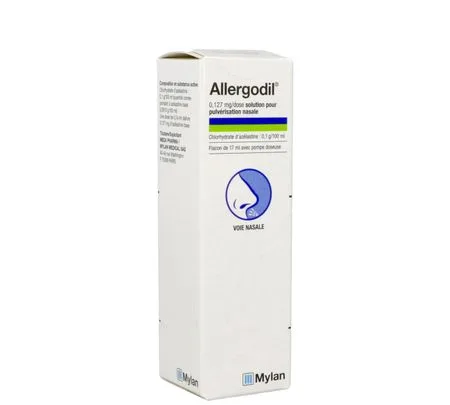
ALLERGODIL 0,127 mg/dose, nasal spray solution
Composition
Azelastine hydrochloride........................................................................................................................0,1000 g
Quantity corresponding to azelastine base.........................................................................................0,0910 g
For 100 mL of solution.
One dose of 0,14 mL delivers 0,127 mg of azelastine base.
Hypromellose, sodium edetate, citric acid, sodium hydrogen phosphate dodecahydrate, sodium chloride, purified water.
Dosage and administration
Nasal use.
Dosage
Adults and children over 6 years:
1 spray(s) (0,14 mL) in each nostril, 2 times a day (corresponding to 0,56 mg of azelastine hydrochloride).
Initiation and duration of treatment depend on allergen exposure.
Warnings and precautions
Precautions for use
In the absence of data, this medicine is not indicated in children under 6 years of age.
Nasal passages must be kept patent to ensure optimal diffusion of the product. Inform the patient, advising them to dry them by blowing their nose before instillation. In case of major nasal obstruction, a detailed examination of the ENT sphere must be carried out.
Interactions
By analogy with the oral route, and although the amounts of azelastine passing into the general circulation after nasal administration are limited, the following data should be taken into account:
Combinations not recommended
+ Alcohol
Alcohol potentiates the sedative effect of azelastine.
Impaired alertness may make driving vehicles and operating machinery dangerous.
Associations to be taken into account
+ Other CNS depressant medicines
Morphine derivatives (analgesics, antitussives and substitution treatments); benzodiazepines; anxiolytics other than benzodiazepines: carbamates, captodiame, etifoxine; hypnotics; sedative antidepressants; central antihypertensives; baclofen, thalidomide.
Increased central depression. Impairment of alertness may make driving vehicles and using machines dangerous.
Fertility, pregnancy and breastfeeding
By analogy with the oral route, and although the amounts of azelastine passing into the general circulation after nasal administration are limited, the following data should be taken into account:
At high oral doses in animals, equivalent to 500 times the proposed daily oral dose in humans, fetal deaths, growth retardation and skeletal malformations were observed during reproduction studies.
There are currently no relevant data, or data in sufficient quantity, to assess a possible teratogenic or fetotoxic effect of azelastine when administered during pregnancy.
Due to nasal administration and the low doses administered, systemic exposure should be negligible.
Consequently, as a precautionary measure, it is preferable not to use this medicine during pregnancy.
Azelastine is excreted in breast milk in small quantities. Consequently, administration of this nasal spray is not recommended during breastfeeding.
Studies carried out in animals have shown a teratogenic effect of azelastine administered orally at very high doses (see section Preclinical safety).
In clinical practice, there is currently no sufficiently relevant data to assess a possible malformative or foetotoxic effect of azelastine when administered during pregnancy.
Consequently, given the available data and the pharmacokinetic properties (low systemic passage), as a precautionary measure, it is preferable not to use azelastine during pregnancy. At the end of pregnancy, consider the possible repercussions for the newborn of the anticholinergic properties of this molecule.
Driving and using machines
Azelastine has a minor influence on the ability to drive vehicles and use machines. Patients should be informed that they may experience drowsiness, dizziness or asthenia when using ALLERGODIL 0,127 mg/dose, nasal spray solution, with inter-individual variability. Consequently, patients should be informed of the need to test their response to this medicine before any activity requiring vigilance, such as driving vehicles or using machines. Particular attention should be paid to the fact that alcohol may increase these effects.
Adverse effects
Possibility of:
• occasional irritation of the nasal mucosa,
• bitterness or taste alteration, particularly if the head is tilted too far back during instillation,
• nausea,
• epistaxis,
• sneezing,
• headaches,
• hypersensitivity reactions (such as rash, pruritus and urticaria).
Exceptionally, cases of drowsiness, dizziness and asthenia have been reported in some subjects.
Reporting of suspected adverse reactions
Reporting suspected adverse reactions after authorisation of the medicinal product is important. It allows continued monitoring of the benefit/risk balance of the medicinal product. Healthcare professionals are asked to report any suspected adverse reaction via the national reporting system: National Agency for the Safety of Medicines and Health Products (ANSM) and the network of Regional Centres of Pharmacovigilance - Website: https://signalement.social-sante.gouv.fr/.
Overdose
The results of animal studies have shown that toxic doses may cause neurological disorders: excitation, tremors, convulsions.
In case of accidental or voluntary overdose: symptomatic treatment must be undertaken. There is no specific antidote. Gastric lavage is recommended if the intoxication is recent.
Incidents of overdose through intranasal administration are nevertheless very unlikely.
Pharmacodynamics
Pharmacotherapeutic class: H1 Antihistamine, ATC code: R01AC03 (R: respiratory system).
Data from clinical studies show that azelastine nasal spray solution has a faster onset of action than desloratadine tablets and intranasally administered mometasone. Relief of allergic symptoms is observed within 15 minutes after administration.
Pharmacokinetics
After repeated nasal administration (0,14 mg in each nostril 2 times daily), plasma concentrations of azelastine are approximately 0,26 ng/mL. Concentrations of the active metabolite desmethylazelastine are around the limit of quantification (0,12 ng/mL) or lower.
After repeated oral administration, the Cmax mean plasma steady-state values were 3,9 ng/mL for azelastine and 1,86 ng/mL for desmethylazelastine (after administration of 2,2 mg of azelastine twice daily, i.e. the oral therapeutic dose for the treatment of allergic rhinitis).
After oral administration, azelastine is rapidly absorbed. Food does not interfere with absorption. The protein binding rate is on average 80%.
The plasma elimination half-lives after single administration of azelastine are approximately 20 hours for azelastine and 45 hours for N-desmethylazelastine (an active metabolite).
They are increased in cases of renal impairment and in elderly subjects.
Elimination is mainly faecal. Prolonged faecal excretion of small quantities of the administered dose suggests the existence of an enterohepatic cycle.
Preclinical safety
Administration of azelastine hydrochloride reveals no sensitizing potential in guinea pigs.
In vitro and in vivo tests in rats and mice of azelastine have revealed no mutagenic or carcinogenic potential.
In male and female rats, azelastine administered orally at doses above 30 mg/kg/day causes a dose-dependent decrease in the fertility index; however, during chronic toxicity studies, no alteration related to this substance was found in the reproductive organs of males and females.
Teratogenic and embryotoxic effects in rats, mice and rabbits appear only at maternally toxic doses (for example, skeletal malformations were observed in rats and rabbits at doses of 50mg/kg/day).
Prescription, supply and reimbursement
| Marketing authorisation (AMM) |
|
| Price: |
|
Collection.
1 RUE DE TURIN
69007 LYON
Tel: 04 37 25 75 00 https://www.viatris.fr/
Source: VIDAL · Updated on 10/11/2026. This information does not replace advice from a healthcare professional.