
Medicines
SmPC of 07/09/2023
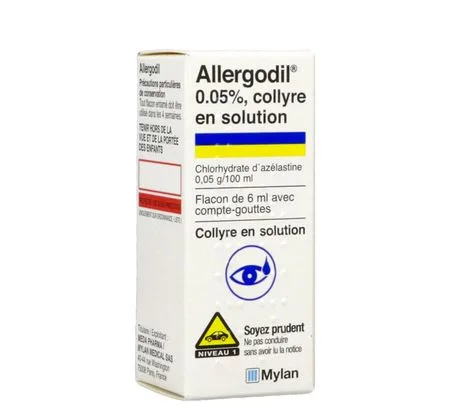
ALLERGODIL 0,05 percent, eye drops in solution
Composition
Azelastine hydrochloride................................................................................................................0,05 g
For 100 ml.
One drop contains 0,015 mg of azelastine hydrochloride.
Excipient with known effect: 1 ml contains 0,125 mg of benzalkonium chloride.
Benzalkonium chloride, hypromellose, sodium edetate, sorbitol at 70 percent (crystallising), sodium hydroxide, water for injections.
Indications
Symptomatic treatment of allergic conjunctivitis in children older than 4 years and in adults.
Dosage and administration
Ophthalmic use.
FOR OCULAR INSTILLATION.
Dosage
The usual dosage is 1 drop, 2 times a day in the affected eye(s).
The dosage may be increased to 1 drop in each affected eye, 4 times a day, during periods of high allergen exposure.
Method of administration
Instil the eye drop into the conjunctival sac, gently pulling the lower eyelid down and looking upward.
Contraindications
Known hypersensitivity to any of the components of the eye drops (in particular azelastine hydrochloride, benzalkonium chloride, sodium edetate).
Warnings and precautions
• The eye drops must not be used for peri- or intra-ocular injection.
• In the absence of data, this medicine is not recommended in children under 4 years of age.
• If symptoms persist or worsen, the patient will be advised to consult a doctor. As with any ophthalmic preparation containing benzalkonium chloride (0,0125%) and due to the risk of adsorption onto lenses, wearing soft hydrophilic contact lenses is not recommended during treatment. Benzalkonium chloride is known to discolour soft contact lenses. They must be removed before application and the patient must wait at least 15 minutes before reinserting them.
• Benzalkonium chloride is known to cause eye irritation and symptoms of dry eye syndrome, and may affect the tear film and corneal surface. It should be used with caution in patients with dry eye and those at risk of corneal damage. Patients should be monitored during prolonged use.
• Azelastine eye drops must not be used for the treatment of eye infections.
Interactions
In case of concomitant treatment with another eye drop, the eye drops should be instilled at 15 minutes' interval.
By analogy with the oral route, and although the amounts of azelastine passing into the systemic circulation after eye instillation are limited, the following data should be taken into account:
Combinations not recommended
+ Alcohol
Alcohol potentiates the sedative effect of azelastine.
Impaired alertness may make driving vehicles and operating machinery dangerous.
Associations to be taken into account
+ Other CNS depressant medicines
The increase in central depression may have significant consequences, particularly when driving.
Fertility, pregnancy and breastfeeding
By analogy with the oral route, and although the amounts of azelastine passing into the systemic circulation after eye instillation are limited, the following data should be taken into account:
At high doses in animals, equivalent to 500 times the proposed daily oral dose in humans, fetal deaths, growth retardation and skeletal malformations were observed during reproduction studies.
There is currently no relevant or sufficient data to assess a possible malformative or fetotoxic effect of azelastine when administered during pregnancy.
Consequently, as a precautionary measure, it is preferable not to use this medicine during pregnancy.
Azelastine is excreted in breast milk in small quantities. Consequently, the administration of this eye drop is not recommended during breastfeeding.
Studies performed in animals have demonstrated a teratogenic effect of azelastine administered orally at very high doses (see section Preclinical safety).
In clinical practice, there is currently no sufficiently relevant data to assess a possible malformative or fetotoxic effect of azelastine when administered during pregnancy.
Consequently, given the available data and the pharmacokinetic properties (low systemic passage), as a precautionary measure, it is preferable not to use azelastine during pregnancy. At the end of pregnancy, consider the possible repercussions for the newborn of the anticholinergic properties of this molecule.
Driving and using machines
Patients experiencing visual disturbance (burning sensation) should refrain from driving vehicles or operating machinery until these symptoms disappear.
Adverse effects
Possibility of:
• Mild and transient burning sensation on instillation,
• Bitter taste sensation, taste alteration,
• Very rarely, sensations of hypersensitivity have been reported.
Due to the presence of benzalkonium chloride, risk of contact eczema and irritation.
Reporting of suspected adverse reactions
Reporting suspected adverse reactions after authorisation of the medicinal product is important. It allows continued monitoring of the benefit/risk balance of the medicinal product. Healthcare professionals are asked to report any suspected adverse reaction via the national reporting system: National Agency for the Safety of Medicines and Health Products (ANSM) and the network of Regional Centres of Pharmacovigilance - Website: https://signalement.social-sante.gouv.fr
Overdose
Overdose incidents by ocular administration are very unlikely.
Results of studies in animals have shown that toxic doses could cause neurological disorders: excitation, tremors, convulsions.
In case of accidental or deliberate overdose: symptomatic treatment must be undertaken. There is no specific antidote. Gastric lavage is recommended if the intoxication is recent.
Pharmacodynamics
Pharmacotherapeutic class: Antiallergic, Antihistamine H1 (S=sensory organs) - ATC code: S01GX07
Pharmacokinetics
Pharmacokinetics specific to the local route
As the doses applied locally are very low in the form of eye drops (maximum of 0,120 mg per day for both eyes), systemic exposure is minimal.
After repeated administration of azelastine eye drops (up to one drop in each eye 4 times per day), steady-state plasma levels are very low, at the limit of quantification (0,25 ng/ml) or below.
General pharmacokinetic properties
After repeated oral administration, the mean steady-state plasma Cmax values were 3,9 ng/ml for azelastine and 1,86 ng/ml for desmethylazelastine (after administration of 2,2 mg of azelastine twice daily, i.e. the dose required for the treatment of allergic rhinitis).
After oral administration, azelastine is highly bound to plasma proteins (80 - 90%). It is excreted via the faecal route.
Its elimination half-life is approximately 20 hours, that of its active metabolite (N-desmethylazelastine) is approximately 45 hours. These half-lives are prolonged in cases of renal impairment and in elderly subjects.
Preclinical safety
Administration of azelastine hydrochloride reveals no sensitizing potential in guinea pigs.
In vitro and in vivo tests in rats and mice of azelastine have revealed no mutagenic or carcinogenic potential.
In male and female rats, azelastine administered orally at doses above 30 mg/kg/day causes a dose-dependent decrease in the fertility index; however, during chronic toxicity studies, no alteration related to this substance was found in the reproductive organs of males and females.
Teratogenic and embryotoxic effects in rats, mice and rabbits appear only at maternally toxic doses (for example, skeletal malformations were observed in rats and rabbits at doses of 50 mg/kg/day).
Prescription, supply and reimbursement
| Marketing authorisation (AMM) |
|
| Price: |
|
Collection.
1 RUE DE TURIN
69007 LYON
Tel: 04 37 25 75 00 https://www.viatris.fr/
Source: VIDAL · Updated on 10/11/2026. This information does not replace advice from a healthcare professional.