
Medicines
Update of 10/07/2025
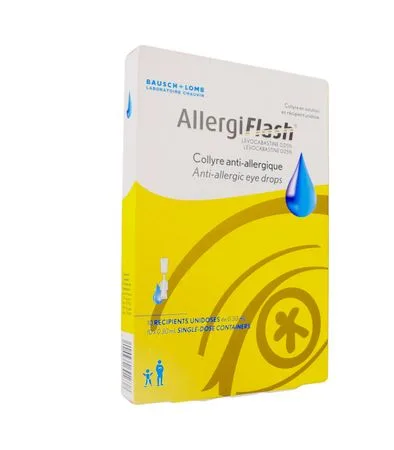
ALLERGIFLASH®
levocabastine
Forms and presentations
Eye drops, solution at 0,05 % (clear, colourless solution): Single-dose containers of 0,3 ml, box of 10.Composition
| per single dose | |
| Levocabastine (INN) hydrochloride expressed as levocabastine
|
0,15 mg |
Excipient with known effect: this medicine contains 2,379 mg of phosphates per single dose.
Indications
Allergic conjunctivitis.Dosage and administration
DosagePaediatric population
The safety and efficacy of ALLERGIFLASH 0,05 %, eye drops in solution in single-dose container, in children aged less than 6 years have not yet been established. These data are limited (see Pharmacodynamics).
Adults and children aged at least 6 years:
The usual recommended dose is 1 drop in each eye, 2 times a day.
This dose may be increased, if necessary, to 1 drop 3 to 4 times a day.
The eye drops should be used at regular intervals.
Treatment should not be continued beyond 5 days without medical advice.
Method of administration:
- Wash hands thoroughly before instillation.
- Avoid touching the eye or eyelids with the tip of the single-dose container.
- Instil one drop of eye drops into the conjunctival sac of the eye, looking upwards and gently pulling the lower eyelid downwards.
- With the eye closed, carefully wipe away the excess, particularly from the cheek.
- In order to avoid systemic effects, it is recommended to press the inner corner of the eye for 1 minute after each instillation.
- Discard the single-dose container immediately after instillation.
If concomitant treatment with another eye drop is used, space the instillations by 15 minutes.
The quantity of eye drops in a single-dose container is sufficient for treating both eyes.
Contraindications
Hypersensitivity to the active substance or to any of the excipients listed in section Composition.Warnings and precautions
ALLERGIFLASH 0,05 %, eye drops in solution in single-dose container must not be used by injection.
Wearing contact lenses is not recommended during treatment.
ALLERGIFLASH 0,05 %, eye drops in solution in single-dose container does not contain a preservative.
This medicine contains phosphate (see Undesirable effects).
Fertility, pregnancy and breastfeeding
Pregnancy:No data concerning the human species is available. Given the negligible systemic passage and the fact that no embryotoxic or teratogenic effect has been reported in animal experiments, the use of ALLERGIFLASH 0,05 %, eye drops in solution in single-dose container may be considered with caution during pregnancy.
Breastfeeding:
Due to the lack of data, the use of levocabastine is not recommended during breastfeeding.
Driving and using machines
A transient visual disturbance due to slight irritation upon instillation of the eye drops may be experienced by the patient. In this case, it is recommended to wait until vision returns to normal before driving a vehicle or using a machine.Adverse effects
Undesirable effects from clinical trials, epidemiological studies and postmarketing data are classified according to their frequency of occurrence, as follows: very common (≥ 1/10), common (≥ 1/100, < 1/10), uncommon (≥ 1/1000, < 1/100), rare (≥ 1/10 000, < 1/1000) and very rare (< 1/10 000).
The frequencies of effects reported after marketing authorisation are not known.
- Eye disorders:
-
- Common: eye pain, blurred vision.
- Uncommon: eyelid oedema.
- Very rare: conjunctivitis, eye swelling, blepharitis, ocular hyperaemia, watery eyes.
A few very rare cases of corneal calcification have been reported in association with the use of drops containing phosphates in some patients with severely damaged corneas.
- Common: eye pain, blurred vision.
- Cardiac disorders:
-
- Very rare: palpitations.
- Very rare: palpitations.
- General disorders and administration site conditions:
-
- Common: administration site reaction including burning/stinging sensation, eye irritation.
- Very rare: administration site reaction including eye redness, ocular pruritus.
- Common: administration site reaction including burning/stinging sensation, eye irritation.
- Immune system disorders:
-
- Very rare: Quincke's oedema, hypersensitivity, anaphylactic reaction.
- Very rare: Quincke's oedema, hypersensitivity, anaphylactic reaction.
- Skin and subcutaneous tissue disorders:
-
- Very rare: contact dermatitis, urticaria.
- Very rare: contact dermatitis, urticaria.
- Nervous system disorders:
-
- Very rare: headache.
- Very rare: headache.
Reporting suspected adverse reactions after authorisation of the medicinal product is important. It allows continuous monitoring of the benefit/risk balance of the medicinal product. Healthcare professionals should report any suspected adverse reaction via the national reporting system: National Agency for the Safety of Medicines and Health Products (ANSM) and the network of Regional Pharmacovigilance Centres. Website: https://signalement.social-sante.gouv.fr.
Overdose
Sedation following accidental overdose cannot be ruled out.
In case of overdose, rinse thoroughly with sterile physiological saline.
Pharmacodynamics
Pharmacotherapeutic class: selective H1 antihistamine, ATC code: S01GX02.
Levocabastine is a potent, selective H1 antihistamine whose action is rapid and prolonged.
After ocular instillation, it rapidly relieves for several hours the symptoms of allergic conjunctivitis (pruritus, erythema, lacrimation, eyelid oedema, chemosis).
Paediatric population
Paediatric studies conducted in the population of children aged 6 to 18 years have confirmed the efficacy of levocabastine in ocular instillations. Usage data in children aged 4 to 6 years have been published. Due to their limited nature, the benefit-risk ratio must be taken into account when using ocular levocabastine in children aged at least 4 years and under 6 years.
Pharmacokinetics
After ocular instillation, levocabastine is gradually and partially absorbed by the mucosa.
Plasma concentrations are too low to produce systemic effects.
Preclinical safety
Non-clinical data for levocabastine from conventional repeated-dose toxicity studies, conducted by oral, intravenous, dermal and ocular routes in different animal species (rat, dog, rabbit), did not reveal any particular risk for humans.
Reproduction studies performed in mice and rats by oral route showed that levocabastine has no adverse effect on reproduction up to 20 mg/kg/day in rats and up to 40 mg/kg/day in mice.
Levocabastine has not shown mutagenic or carcinogenic potential.
No ophthalmological abnormalities were observed in rabbits after instillation of one drop of ALLERGIFLASH 0,05 %, eye drops in solution in single-dose container 4 times per day for 4 weeks.
Storage conditions
Shelf life 2 years.
No special precautions for storage.
Do not reuse an opened single-dose container.
Use the single-dose container immediately after opening and discard it after use.
HANDLING/DISPOSAL INSTRUCTIONS
No special requirements.
Any unused medicinal product or waste material should be disposed of in accordance with local requirements.
Prescription, supply and reimbursement
| Marketing authorisation (AMM) | 3400934691638 (2010, SmPC rev 17.02.2023). |
| Not reimbursed by Social Security. |
CHAUVIN Laboratory
416, rue Samuel-Morse. CS 99535. 34961 Montpellier
Tel: 04 67 12 30 30
Source: VIDAL · Updated on 10/11/2026. This information does not replace advice from a healthcare professional.