
Medicines
SmPC of the 03/10/2023
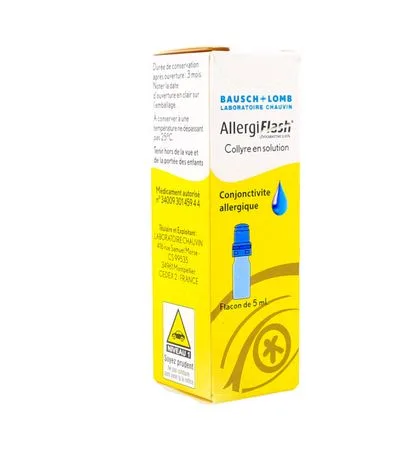
ALLERGIFLASH 0,05 %, eye drops in solution
Composition
Levocabastine................................................................................................................................................0,05 g
In the form of levocabastine hydrochloride
For 100 mL of solution
Excipients with known effect: This medicine contains 39,65 mg of phosphates per 5 mL.
Hydroxypropylbetadex, sodium phosphate monobasic dihydrate, sodium phosphate dibasic dodecahydrate, sodium chloride, purified water.
Dosage and administration
Dosage
Paediatric population
The safety and efficacy of ALLERGIFLASH 0,05%, eye drops in solution in children aged under 6 years have not yet been established. These data are limited (see section Pharmacodynamics).
Adults and children aged at least 6 years: the usual recommended dose is 1 drop in each eye, 2 times a day.
This dose may be increased, if necessary, to 1 drop 3 to 4 times a day.
The eye drops should be used at regular intervals.
Treatment should not be continued beyond 5 days, without medical advice.
Method of administration
Wash hands thoroughly.
A. Before the very first instillation into the eye (first use)
1. Remove the safety ring.
2. Remove the protective cap.
3. Hold the bottle upside down and press firmly on the middle of the bottle so as to release 1 to 2 drops.
B. To instil the eye drops into the eye
1. Looking upwards and pulling the lower eyelid down, position the bottle above the eye and gradually press on the middle of the bottle until the drop arrives.
Avoid touching the eye or eyelid with the tip of the bottle.
2. Blink once so that the eye drops spread over the entire surface of the eye.
With the eye closed, carefully wipe off the excess.
3. In order to avoid systemic effects, it is recommended to compress the inner corner of the eye for 1 minute after each instillation while keeping the eye closed.
4. Replace the protective cap after use.
C. If the drop does not appear, repeat steps A2 and A3.
If concomitant treatment with another eye drop is used, space the instillations by 15 minutes.
This eye drop does not contain a preservative.
Contraindications
Hypersensitivity to the active substance or to any of the excipients listed in section Composition.
Fertility, pregnancy and breastfeeding
Pregnancy
No data concerning the human species are available. Given the negligible systemic passage and the fact that no embryotoxic or teratogenic effect has been reported in animal experiments, the use of ALLERGIFLASH 0,05 %, eye drops in solution may be considered with caution during pregnancy.
Breast-feeding
Due to the absence of data, the use of levocabastine is not recommended during breastfeeding.
Driving and using machines
A transient visual disturbance due to slight irritation upon instillation of ALLERGIFLASH 0,05 %, eye drops in solution may be experienced by the patient. In this case, it is recommended to wait until normal vision returns before driving a vehicle or operating a machine.
Adverse effects
Adverse effects from clinical trials, epidemiological studies and post-marketing data are classified by frequency of occurrence, as follows: very common (≥ 1/10), common (≥ 1/100, <1/10), uncommon (≥1/1000, < 1/100), rare (≥1/10000, <1/1000) and very rare (<1/10000). The frequencies of effects reported after marketing are not known.
Eye disorders
Common: Eye pain, blurred vision
Uncommon: eyelid oedema
Very rare: conjunctivitis, eye swelling, blepharitis, ocular hyperaemia, watery eyes
A few very rare cases of corneal calcification have been reported in association with the use of drops containing phosphates in some patients with severely damaged corneas.
Cardiac disorders
Very rare: palpitations
General disorders and administration site conditions
Common: Administration site reaction including burning/stinging sensation, eye irritation.
Very rare: Administration site reaction including eye redness, ocular pruritus.
Immune system disorders
Very rare: Quincke's oedema, hypersensitivity, anaphylactic reaction.
Skin and subcutaneous tissue disorders
Very rare: Contact dermatitis, urticaria.
Nervous system disorders
Very rare: Headache.
Reporting of suspected adverse reactions
Reporting suspected adverse reactions after authorisation of the medicinal product is important. It allows continued monitoring of the benefit/risk balance of the medicinal product. Healthcare professionals are asked to report any suspected adverse reaction via the national reporting system: National Agency for the Safety of Medicines and Health Products (ANSM) and the network of Regional Centres of Pharmacovigilance - Website: https://signalement.social-sante.gouv.fr/ .
Overdose
Sedation following accidental overdose cannot be excluded.
In case of overdose, rinse thoroughly with sterile physiological saline.
Pharmacodynamics
Pharmacotherapeutic class: Decongestant and antiallergic, ATC code: S01GX02.
Mechanism of action
Levocabastine is a selective, potent H1-antihistamine whose action is rapid and prolonged.
After ocular instillation, it rapidly relieves for several hours the symptoms of allergic conjunctivitis (pruritus, erythema, lacrimation, eyelid edema, chemosis).
Paediatric population
Pediatric studies conducted in the population of children aged 6 to 18 years confirmed the efficacy of levocabastine in ocular instillations. Usage data in children aged 4 to 6 years have been published. Due to their limited nature, the benefit-risk ratio must be considered when using ocular levocabastine in children aged at least 4 years and less than 6 years.
Pharmacokinetics
Absorption
After ocular instillation, levocabastine is gradually and partially absorbed by the mucosa.
In patients with allergic conjunctivitis, the absolute bioavailability is approximately 30% after a single ocular administration of levocabastine eye drops suspension; after repeated ocular administration of one drop in each of the 2 eyes up to 4 times daily for 4 weeks, steady-state plasma levels are between 0,24 and 0,83 ng/mL.
Biotransformation
After a single oral administration (0,5 mg, 1 mg and 2 mg), levocabastine is rapidly and completely absorbed (Tmax = 2 hours). After oral administration of 0,5 mg of levocabastine solution, the bioavailability is, on average, 112%. The half-life (35 to 45 hours) is not modified after repeated administration.
Elimination
At steady state after 9 days of repeated oral administration (0,5 mg/day), plasma concentrations average 12,3 ng/mL. Elimination of levocabastine occurs mainly via the renal route, primarily in unchanged form.
Preclinical safety
Non-clinical data on levocabastine from the literature have not revealed any particular risk for humans following intravenous, oral and cutaneous administration. After ocular instillation in rabbits, measured plasma concentrations of levocabastine are low. No systemic effect is therefore expected.
The tolerance study in rabbits with the ALLERGIFLASH 0,05% formulation did not reveal any particular risk for humans following administration 4 times daily for 4 weeks.
Special storage precautions
Store at a temperature not exceeding 25°C.
For storage conditions of the medicine after first opening, see section Shelf life.
SPECIAL PRECAUTIONS FOR DISPOSAL AND OTHER HANDLING
No special requirements.
Any unused medicinal product or waste material should be disposed of in accordance with local requirements.
Prescription, supply and reimbursement
| Marketing authorisation (AMM) |
|
416 RUE SAMUEL MORSE CS 99535
34961 MONTPELLIER CEDEX 2
Tel: 04 67 12 30 30 https://www.bausch.com/
Source: VIDAL · Updated on 10/11/2026. This information does not replace advice from a healthcare professional.