Medicines
SmPC of 19/07/2021
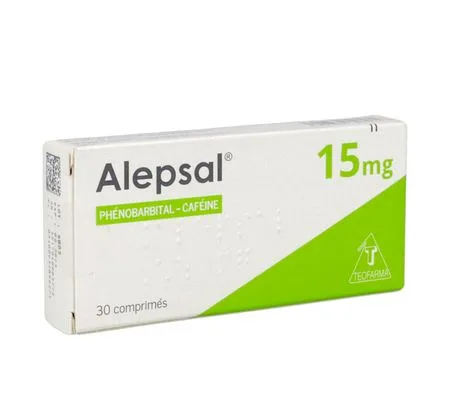
ALEPSAL 15 mg, tablet
Composition
Phenobarbital........................................................................................................................................ 15,000 mg
Anhydrous caffeine...................................................................................................................................... 3,750 mg
For one tablet
Sodium carboxymethylcellulose polymer (ACDISOL), polysorbate 80, povidone (PLASDONE KW 29-32), magnesium stearate, microcrystalline cellulose (EMCOCELL), caramel, cupric chlorophyllin 100 %.
Indications
- In adults
- either as monotherapy,
- or in combination with another antiepileptic treatment:
- Treatment of generalised epilepsies: clonic, tonic, tonic-clonic seizures.
- Treatment of partial epilepsies: partial seizures with or without secondary generalisation.
- In children
- either as monotherapy,
- or in combination with another antiepileptic treatment:
- Treatment of generalised epilepsies: clonic, tonic, tonic-clonic seizures.
- Treatment of partial epilepsies: partial seizures with or without secondary generalisation.
Dosage and administration
Dosage
The efficacy of the medicine can only be judged after 15 days of treatment.
The same applies to any change in dosage.
When clinically justified, monitor the barbiturate level, preferably by sampling in the morning (generally 65 to 130 μmol/L in adults, i.e. 15 to 30 mg/L, and 85 μmol/L, i.e. 20 mg/L in children).
Children: according to weight:
less than 20 kg: 5 mg/kg per day
between 20 and 30 kg: 3 to 4 mg/kg per day
above 30 kg: 2 to 3 mg/kg per day
Adults : 2 to 3 mg/kg per day.
Method of administration
In children under 6 years, the tablet should be crushed and mixed with food before administration because of the risk of choking.
In adults, a single intake per day (see section Pharmacokinetics) at bedtime.
Contraindications
- Hypersensitivity to the active substances, barbiturates or any of the excipients mentioned in section Composition.
- Porphyrias.
- Severe respiratory failure.
- Treatment with Saquinavir and Ifosfamide (phenobarbital used for prophylactic purposes).
- In combination with St John's wort.
This medicine is generally not recommended in the following situations:
- In combination with alcohol and estroprogestins and progestins used as contraceptives (see section Interactions).
- Breastfeeding.
Warnings and precautions
Phenobarbital is not effective in absence seizures and myoclonic seizures, which may sometimes be aggravated.
The introduction of an antiepileptic medicine may, rarely, be followed by a recurrence of seizures or the appearance of a new type of seizure in the patient, independently of fluctuations observed in certain epileptic diseases. With regard to phenobarbital, the causes of these aggravations may be: an inappropriate choice of medicine with respect to the patient's seizures or epileptic syndrome, a change in concomitant antiepileptic treatment or a pharmacokinetic interaction with it, toxicity or overdose. There may be no other explanation than a paradoxical reaction.
Prolonged intake of phenobarbital may lead to the development of a dependence syndrome. If the patient needs to stop treatment, it is recommended to gradually reduce the dose. As with any antiepileptic, abrupt discontinuation of treatment may lead to the onset of seizures and status epilepticus, especially in cases of concomitant alcoholism.
Women of childbearing potential and pregnant women
Phenobarbital must not be used in women of childbearing potential and pregnant women unless there is no less teratogenic therapeutic alternative, because of its teratogenic potential (see section Fertility, pregnancy and breastfeeding). If treatment with phenobarbital is started in a woman of childbearing potential:
- it must be ensured that she is not pregnant;
- the patient must be fully informed of the risks associated with the use of phenobarbital during pregnancy;
- the patient must use effective contraception, taking into account the risk of contraceptive failure due to the enzyme-inducing nature of phenobarbital (see sections Interactions and Fertility, pregnancy and breastfeeding)
The benefit-risk ratio must be carefully reassessed at regular intervals during treatment, at puberty, and urgently when a woman of childbearing potential treated with phenobarbital is planning a pregnancy or in case of pregnancy.
Administration of phenobarbital will be discontinued in the event of hypersensitivity reactions, skin or hepatic involvement.
Possibly reduce the dose in patients with renal impairment, hepatic impairment (biological monitoring, due to the risk of hepatic encephalopathy), the elderly and alcoholics.
Consumption of alcoholic beverages is strongly discouraged during treatment (mutual potentiation).
In children receiving long-term treatment with phenobarbital, add prophylactic treatment for rickets: vitamin D2 (1200 to 2000 IU/day) or 25-OH-vitamin D3.
Interactions
Contraindicated combinations
Saquinavir
Risk of decreased efficacy of saquinavir due to increased hepatic metabolism by the inducer.
Ifosfamide (Phenobarbital for prophylactic purposes).
Risk of increased neurotoxicity due to increased hepatic metabolism of ifosfamide by phenobarbital.
St John's wort
Risk of decreased plasma concentrations and efficacy of the anticonvulsant.
Combinations not recommended
Alcohol:
Alcohol increases the sedative effect of phenobarbital. Impaired alertness may make driving vehicles and using machinery dangerous.
Avoid taking alcoholic beverages and medicines containing alcohol.
Estroprogestogens and progestogens (contraceptives) (see section Fertility, pregnancy and breastfeeding) :
Decreased contraceptive efficacy, due to increased hepatic metabolism of the hormonal contraceptive by the inducer.
If the combination proves necessary, use an additional mechanical method for the duration of phenobarbital treatment, and for two cycles following discontinuation of the inducer.
Associations subject to Precautions for use
Valproic acid, valpromide
Increased plasma concentrations of phenobarbital, with signs of overdose, due to inhibition of hepatic metabolism, most often in children. In addition, decreased plasma concentrations of valproic acid due to increased hepatic metabolism by phenobarbital.
Clinical monitoring during the first 15 days of the combination and immediate reduction of phenobarbital doses as soon as signs of sedation appear; monitor plasma concentrations of both antiepileptics.
Oral anticoagulants
Decreased effect of the oral anticoagulant (increased hepatic metabolism).
More frequent monitoring of prothrombin level and INR monitoring. Adjust the dose of the oral anticoagulant during phenobarbital treatment and for 8 days after its discontinuation.
Imipramine-type antidepressants
Imipramine-type antidepressants promote the occurrence of generalised convulsive seizures.
Clinical monitoring and possible increase in antiepileptic doses.
Ciclosporin, tacrolimus
(By extrapolation from rifampicin).
Decreased plasma concentrations and efficacy of the immunosuppressant due to increased hepatic metabolism.
Increase the immunosuppressant dose under monitoring of plasma concentrations. Decrease the dose upon discontinuation of the inducer.
Corticosteroids (gluco-, mineralo-)
(Systemic route) (except hydrocortisone used as replacement therapy in Addison's disease).
Decreased plasma concentrations and efficacy of corticosteroids due to increased hepatic metabolism: the consequences are particularly significant in patients with Addison's disease and in cases of transplantation.
Clinical and biological monitoring; adjust the corticosteroid dose during treatment with the inducer and after its discontinuation.
Digitoxin
Decreased plasma concentrations and efficacy of digitoxin (increased hepatic metabolism).
Clinical monitoring, ECG and possibly monitoring of digitoxin levels. If necessary, adjust the digitoxin dose during the combination and after phenobarbital discontinuation, or prefer digoxin, which is less metabolised by the liver.
Disopyramide
Decreased plasma concentrations and efficacy of the antiarrhythmic (increased hepatic metabolism).
Clinical monitoring, ECG and possibly monitoring of disopyramide plasma concentrations. If needed, adjust the disopyramide dose during phenobarbital treatment and after its discontinuation.
Dihydropyridines
Decrease in plasma concentrations of dihydropyridine due to increased hepatic metabolism.
Clinical monitoring and possible dose adjustment of dihydropyridine during treatment with the inducer and after its discontinuation.
Doxycycline
Decrease in plasma concentrations of doxycycline due to increased hepatic metabolism.
Clinical monitoring and possible dose adjustment of doxycycline.
Estrogens and progestogens (non-contraceptive)
Decrease in the efficacy of the estrogen or progestogen due to increased hepatic metabolism.
Clinical monitoring and possible dose adjustment of the estrogen or progestogen during treatment with the inducer and after its discontinuation.
Folates
Decrease in plasma concentrations of phenobarbital, due to increased metabolism, of which folates are one of the cofactors.
Clinical monitoring, monitoring of plasma concentrations, and adjustment, if necessary, of the phenobarbital dose during folic acid supplementation and after its discontinuation.
Thyroid hormones
Described for phenytoin, rifampicin, carbamazepine.
Risk of clinical hypothyroidism in hypothyroid patients, due to increased metabolism of T3 and T4.
Monitoring of serum concentrations of T3 and T4 and adjustment, if needed, of the thyroid hormone dose during treatment with the inducer and after its discontinuation.
Hydroquinidine, quinidine
Decrease in plasma concentrations and efficacy of quinidine-type drugs (increased hepatic metabolism).
Clinical monitoring, ECG and monitoring of plasma concentrations; if necessary, adjustment of the antiarrhythmic dose during treatment with the inducer and after its discontinuation.
Ifosfamide
Risk of increased neurotoxicity due to increased hepatic metabolism of ifosfamide by phenobarbital.
In case of treatment with phenobarbital prior to chemotherapy: clinical monitoring and adjustment of the anticancer drug dose.
Itraconazole
Decrease in plasma concentrations and efficacy of itraconazole.
Clinical monitoring and, if necessary, measurement of plasma itraconazole and possible dose adjustment.
Methadone
Increased risk of respiratory depression, which may be fatal in the event of overdose.
In addition, decrease in plasma methadone concentrations with risk of withdrawal syndrome occurring due to increased hepatic metabolism.
Regular clinical monitoring and methadone dose adjustment.
Progabide
Possible increase in plasma concentrations of phenobarbital.
Probable decrease in plasma progabide concentrations (not verified).
Clinical monitoring and monitoring of plasma phenobarbital concentrations.
Possible dose adjustments.
Theophylline (base and salts) and aminophylline
Decrease in plasma concentrations and activity of theophylline due to increased hepatic metabolism.
Clinical monitoring and, if necessary, theophyllinemia monitoring. Possible adjustment of the theophylline dosage during treatment with the inducer and after its discontinuation.
Valproate
Patients treated in combination with valproate and phenobarbital should be monitored for signs of hyperammonemia. In half of the reported cases, hyperammonemia was asymptomatic and did not necessarily result in clinical encephalopathy.
Zidovudine
(By extrapolation from rifampicin).
Risk of decreased efficacy of zidovudine due to accelerated hepatic metabolism.
Regular clinical monitoring.
Associations to be taken into account
Alprenolol, metoprolol, propranolol
(Beta-blockers)
Decrease in plasma concentrations of these beta-blockers with reduction of their clinical effects (accelerated hepatic metabolism).
To be taken into account for these beta-blockers, which are eliminated mainly by hepatic biotransformation.
Other central nervous system antidepressants:
Morphine derivatives (analgesics, antitussives and substitution treatments); benzodiazepines; anxiolytics other than benzodiazepines: carbamates, captodiame, etifoxine; hypnotics; sedative antidepressants; neuroleptics; sedative H1 antihistamines; central antihypertensives; baclofen; thalidomide.
Increased central depression. Impaired alertness may make driving vehicles and using machines dangerous.
Carbamazepine
Progressive decrease in plasma concentrations of carbamazepine and its active metabolite without apparent change in anticonvulsant efficacy.
To be taken into account, in particular for the interpretation of plasma concentrations.
Methotrexate
Increased hematologic toxicity due to additive inhibition of dihydrofolate reductase.
Morphine (analgesics), benzodiazepines
Increased risk of respiratory depression, which may be fatal in the event of overdose.
Phenytoin
- In case of prior treatment with phenobarbital and addition of phenytoin, increased plasma concentrations of phenobarbital which may lead to toxic signs (metabolic inhibition by competition).
- In case of prior treatment with phenytoin and addition of phenobarbital, unpredictable variations:
- plasma concentrations of phenytoin are most often decreased (increased metabolism) without this decrease adversely affecting anticonvulsant activity. On discontinuation of phenobarbital, possibility of toxic effects of phenytoin;
- occasionally phenytoin concentrations may be increased (metabolic inhibition by competition).
Procarbazine
Increased hypersensitivity reactions (hypereosinophilia, rash) due to increased metabolism of procarbazine.
Fertility, pregnancy and breastfeeding
Women of childbearing potential/Contraception
Phenobarbital should not be used in women of childbearing potential and pregnant women, except in the absence of a less teratogenic therapeutic alternative. When starting treatment in a woman of childbearing potential, the absence of pregnancy should be ensured and she should be informed of the risk in case of exposure during pregnancy. Women of childbearing potential must use effective contraception during treatment and for 2 months after discontinuation of treatment. Due to the enzyme-inducing nature of phenobarbital, treatment with ALEPSAL may lead to a decrease in the effectiveness of oral contraceptives containing estrogens and/or progesterone. If the combination proves necessary, use an additional mechanical method.
If pregnancy is planned, discontinuation of treatment should be considered except in the absence of a less teratogenic therapeutic alternative.
Pregnancy
Risk related to epilepsy and antiepileptic drugs in general :
Specialist medical advice must be given to women of childbearing potential, with regular reassessment of treatment by a specialist physician. These women must be informed, before starting treatment, of the need to anticipate a pregnancy plan. When a woman is considering pregnancy, the need for antiepileptic treatment must be reassessed and appropriate follow-up put in place. Antiepileptic polytherapy may be associated with a higher risk of congenital malformations than monotherapy; this risk varies depending on the co-administered antiepileptics and is, in particular, greater if the polytherapy includes valproate.
In women treated for epilepsy, abrupt discontinuation of antiepileptic treatment must be avoided because it may lead to recurrence of seizures, the consequences of which for the mother and fetus may be serious.
Risk related to phenobarbital :
In humans, phenobarbital may carry a risk of malformations approximately 3 times higher than that of the general population, which is 2-3%, in particular cleft lip and/or cleft palate, cardiac malformations and hypospadias. Facial dysmorphism, microcephaly and hypoplasia of the nails and fingers have also been reported. Published data suggest a dose-effect relationship, but this remains to be confirmed. Studies on neurodevelopmental disorders in children exposed in utero to phenobarbital are contradictory, but they do not allow a risk to be ruled out.
Phenobarbital crosses the placenta, and maternal and neonatal concentrations are similar.
In view of these data, phenobarbital must not be used in women of childbearing potential and pregnant women, except in the absence of a less teratogenic therapeutic alternative.
In women of childbearing potential :
- The use of less teratogenic therapeutic alternatives is recommended;
- If phenobarbital treatment is initiated:
- it must be ensured that the woman of childbearing potential is not pregnant
- patients must be informed of the risks of using phenobarbital during pregnancy and of the need to anticipate a pregnancy plan;
- patients must use effective contraception during treatment and for 2 months after treatment discontinuation. Due to the enzyme-inducing nature of phenobarbital, treatment with ALEPSAL may lead to failure of oral contraceptives containing estrogens and/or progesterone. If the combination proves necessary, use an additional mechanical method.
If a woman is considering pregnancy and in pregnant women :
- A preconception visit is recommended
- Discontinuation of treatment must be considered, except in the absence of a less teratogenic therapeutic alternative
- The patient must be fully informed of the risks
- If, after reassessment, phenobarbital treatment absolutely had to be maintained during pregnancy:
- the minimum effective dose should be administered. Regular monitoring of plasma concentrations is recommended to adjust the dose.
- the efficacy of folic acid supplementation has not been established to date in women exposed to phenobarbital. However, given its beneficial effect in other situations, it may be proposed at a dose of 5 mg/day for 1 month before and 2 months after conception.
- specialized prenatal surveillance focused on the malformations described above must be instituted.
- Screening for malformations will be identical whether or not the patient has received folic acid.
Before delivery / In the newborn :
Enzyme-inducing antiepileptics may sometimes cause in the newborn of a treated mother:
- a haemorrhagic syndrome that may occur during delivery or in the first days of life. Prevention with vitamin K1 orally in the mother in the month preceding delivery and administration of vitamin K1 parenterally (IM or slow IV) at birth in the newborn appear effective. A normal haemostasis workup in the mother does not rule out haemostasis abnormalities in the newborn.
- disturbances of phosphocalcic metabolism and bone mineralization, which maternal vitamin D supplementation during the 3rd trimester appears able to prevent.
- Symptoms related to phenobarbital exposure of the newborn, including sedation, hypotonia and poor suckling.
- Rarely: a moderate withdrawal syndrome (abnormal movements, ineffective suckling).
Postnatal follow-up / In children : in case of exposure during pregnancy, close monitoring of the child's neurobehavioral development should be instituted and appropriate management should be put in place as early as necessary.
Breast-feeding
Not recommended, due to the possibility of sedation that may cause suckling difficulties leading to poor weight gain in the immediate neonatal period.
Driving and using machines
Attention is drawn, particularly for drivers of vehicles and users of machinery, to the risks of drowsiness and dizziness associated with the use of phenobarbital.
Adverse effects
The classification of adverse events according to their frequency is as follows: Very common (≥ 10 %); Common (≥1 % - <10 %); Uncommon (≥ 0,1 % - <1 %); Rare (≥ 0,01 % - <0,1 %); Very rare (<0,01%); Not known (cannot be estimated from the available data)
Nervous system disorders
- Common: drowsiness early in the day, cognitive disorders, memory impairment
- Uncommon: disorders of coordination and balance, dizziness, headache
- Rare: disturbance of attention
- Frequency not known: difficulty waking with sometimes difficulty articulating
Psychiatric disorders
- Common: behavioural abnormalities, agitation, aggression
- Uncommon: mood disorders
- Frequency not known: prolonged intake of phenobarbital (100 mg per day for 3 months) may lead to the onset of a dependence syndrome.
Skin and subcutaneous tissue disorders
- Common: allergic dermatitis
- Frequency not known:
- Morbilliform or scarlatiniform maculopapular eruptions
- Severe cutaneous reactions including Lyell's syndrome, Stevens-Johnson syndrome, and exfoliative dermatitis.
- Hypersensitivity syndrome: multisystem hypersensitivity reactions most often with fever, skin rash, eosinophilia and hepatic involvement. The existence of rare cases of cross-reactions between phenobarbital, phenytoin and carbamazepine calls for caution when replacing phenobarbital with either of these molecules.
Hepatobiliary disorders
- Common: isolated increase in gamma-glutamyltranspeptidase, linked to the hepatic enzyme-inducing property of phenobarbital. As a general rule, this increase is without clinical significance. Isolated, moderate elevation of a transaminase and/or alkaline phosphatases.
- Frequency not known: hepatitis.
Musculoskeletal and systemic disorders
- Common: retraction of the palmar aponeurosis (Dupuytren's disease).
- Uncommon: arthralgia (shoulder-hand syndrome or gardenal rheumatism)
- Frequency not known:
- Retraction of the plantar aponeurosis (Ledderhose disease), induration of the corpora cavernosa (Peyronie's disease)
Cases of decreased bone mineral density, osteopenia, osteoporosis and fractures have been reported in patients treated long-term with ALEPSAL. The mode of action of ALEPSAL on bone metabolism is not known.
Blood and lymphatic system disorders
- Frequency not known: pancytopenia, aplastic anaemia, megaloblastic anaemia due to folic acid deficiency, agranulocytosis, neutropenia, leukopenia, thrombocytopenia.
Gastrointestinal disorders
- Common: nausea, vomiting.
Congenital, familial and genetic disorders:
- Frequency not known: congenital malformations, other developmental abnormalities (see sections Warnings and precautions and Fertility, pregnancy and breastfeeding)
Serious effects affecting the hepatic and/or dermatological systems as well as hypersensitivity reactions require discontinuation of treatment.
Reporting of suspected adverse reactions
Reporting suspected adverse reactions after authorisation of the medicinal product is important. It allows continued monitoring of the benefit/risk balance of the medicinal product. Healthcare professionals are asked to report any suspected adverse reaction via the national reporting system: National Agency for the Safety of Medicines and Health Products (ANSM) and the network of Regional Centres of Pharmacovigilance - Website: www.ansm.sante.fr.
Overdose
Within the hour following massive ingestion, the following occur: nausea, vomiting, headache, obnubilation, mental confusion or even coma accompanied by a characteristic neurovegetative syndrome (irregular bradypnea, tracheobronchial congestion, arterial hypotension).
Treatment: forced diuresis, alkalinisation, respiratory assistance, antibiotic therapy, potassium supplementation.
Pharmacodynamics
Pharmacotherapeutic class: ANTIEPILEPTIC; ATC code: N03AA02
ALEPSAL consists of:
- phenobarbital:
- Phenobarbital is a barbiturate. It has anticonvulsant, sedative and hypnotic properties.
- caffeine: attenuates drowsiness at the start of treatment depending on the sensitivity of the subject.
Pharmacokinetics
Approximately 80% of orally administered phenobarbital is absorbed from the gastrointestinal tract; the plasma peak is reached in approximately 8 hours in adults and in approximately 4 hours in children.
The plasma half-life is 50 to 140 h in adults and 40 to 70 h in children. It increases in cases of hepatic or renal insufficiency and in elderly subjects.
Phenobarbital distributes throughout the body, notably into the brain due to its lipid solubility; it crosses the placental barrier and passes into breast milk.
Phenobarbital is partially bound to plasma proteins (50% in adults and 60% in children).
It is both metabolised in the liver (into an inactive hydroxylated derivative, which is then glucuronide- or sulfate-conjugated) and excreted by the kidney unchanged (all the more so when the urine is alkaline).
Prescription, supply and reimbursement
| Marketing authorisation (AMM) |
|
| Price: |
|
Collection.
VIA F.LLI CERVI, 8
27010 VALLE SALIMBENE (PAVIA)
Tel: 00 39 0382 422 008 amministrazione@teofarma.it
https://www.teofarmasrl.it/
Source: VIDAL · Updated on 10/11/2026. This information does not replace advice from a healthcare professional.