
Medicines
Update of the 19/03/2025
*ALCAPHOR®
tromethamol, sodium and potassium citrates
Forms and presentations
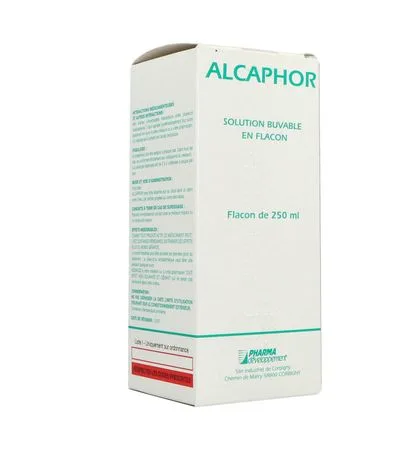
Oral solution: Bottle of 250 mL.Composition
| p 100 mL | |
| Tromethamol* (INN) citrate
|
27,47 g |
| (i.e. as tromethamol: 15,33 g)
|
|
| Anhydrous disodium citrate
|
1,59 g |
| Anhydrous dipotassium citrate
|
3,62 g |
Excipients with known effect: benzoic acid (E210) (15 mg per tablespoon), sodium (46 mg per tablespoon) and potassium (156 mg per tablespoon).
* Or tris-(hydroxymethyl) aminomethane or THAM.Indications
Alkalinizing agent in hyperuraturia during hyperuricemia or during uricosuric and uricolytic treatments for the prevention of lithiasis formation.Proposed in the formation of cystinic lithiasis.
Prevention of metabolic acidosis.
Dosage and administration
The average dose is 2 to 4 tablespoons per day. Have the patient establish a urinary pH curve. A urinary pH between 6,5 and 7 must be obtained. If necessary, the dose should be reduced or increased.
Alcaphor oral solution in bottle may be used neat or diluted in half a glass of water and should be taken in small sips during meals.
Contraindications
- Hypersensitivity to the active substances or to any of the excipients listed in section Composition.
- Anuria and severe renal insufficiency with creatinine clearance below 10 mL/min.
- Alkaloses.
- Diarrhoea and transit disorders in gastrectomised and colectomised patients.
Warnings and precautions
Urinary pH must be monitored regularly.
This medicine contains 15 mg of benzoic acid per tablespoon of 15 mL oral solution.
This medicine contains 46 mg of sodium per tablespoon, which is equivalent to 2,3 % of the WHO's maximum recommended daily dietary intake of 2 g of sodium per adult.
This medicine contains 156 mg of potassium per tablespoon. To be taken into account in patients with renal impairment or in patients monitoring their dietary potassium intake.
Interactions
Drug interactionsUrinary alkalinisation induced by Alcaphor, oral solution in a bottle, decreases the renal excretion of quinidine and may lead to an increase in plasma quinidine levels.
Fertility, pregnancy and breastfeeding
Pregnancy
Due to the lack of data, it is preferable not to use this medicine during pregnancy.
Breast-feeding
Due to the lack of data on the passage of this medicine into breast milk, its use should be avoided during breastfeeding.
Adverse effects
Intestinal transit may be accelerated during the first days of treatment; prescribing an antidiarrhoeal may be useful for a few days.
Reporting of suspected adverse reactions:Reporting suspected adverse reactions after authorisation of the medicinal product is important. It allows continuous monitoring of the benefit/risk balance of the medicinal product. Healthcare professionals should report any suspected adverse reaction via the national reporting system: National Agency for the Safety of Medicines and Health Products (ANSM) and the network of Regional Pharmacovigilance Centres. Website: https://signalement.social-sante.gouv.fr.
Overdose
In case of overdose, the blood acid-base balance and diuresis should be monitored. Symptomatic treatment may be prescribed.
Pharmacodynamics
Pharmacotherapeutic class: urinary alkalinising agent. ATC code: G04BC.
Citrate solution containing THAM, a buffering and alkalinising substance (pH = 8,2).
Alcaphor, oral solution in a bottle, once absorbed, acts by capturing H+. Alcaphor oral solution in a bottle behaves as a cation, which will be eliminated by the kidney with an equimolecular quantity of bicarbonate anion. This results in urinary alkalinisation that is proportional to the quantity ingested and which most often allows a urinary pH between 6,5 and 7 to be obtained within 48 hours.
Alcaphor oral solution in a bottle thus helps prevent the formation of uric acid or cystine stones and may make it possible to dissolve stones of the same nature.
Pharmacokinetics
After oral administration, 15 to 25 % of the ingested THAM is eliminated via the faeces. The remainder, 75 to 85 %, is absorbed by the digestive mucosa and then excreted in the urine within the following 12 hours.
STORAGE CONDITIONS
Store at room temperature.
Shelf life 3 years.
HANDLING/DISPOSAL INSTRUCTIONS
Any unused medicinal product or waste material should be disposed of in accordance with local requirements.
Prescription, supply and reimbursement
LIST I| Marketing authorisation (AMM) | 3400931268949 (1969, SmPC rev 04.06.2024). |
| Not reimbursed by Social Security. |
PHARMA DEVELOPPEMENT SA
Chemin de Marcy. 58800 Corbigny
Tel: 03 86 20 21 64
www.pharmadeveloppement.com
Source: VIDAL · Updated on 10/11/2026. This information does not replace advice from a healthcare professional.