
Medicines
SmPC of 10/02/2026
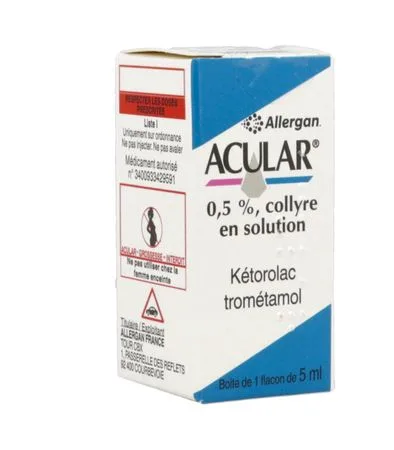
ACULAR 0,5%, eye drops in solution
Composition
Ketorolac tromethamine .............................................................................................................................. 5 mg/ml
Excipient(s) with known effect: Benzalkonium chloride 0,1 mg/ml.
Sodium chloride.
Benzalkonium chloride.
Disodium edetate.
Octoxinol 40.
Sodium hydroxide or hydrochloric acid (diluted) to adjust the pH.
Purified water.
Indications
Prevention and treatment of ocular inflammation in the immediate aftermath of cataract surgery, with or without implant placement.
ACULAR is indicated in adults.
Dosage and administration
Dosage
The recommended dosage is 1 or 2 drops in the affected eye every 6 to 8 hours for 21 days, starting the instillations 24 hours before the procedure.
Paediatric population
There is no justified use of ACULAR in the paediatric population for this indication.
Elderly patients
No difference in safety and efficacy has been observed between elderly patients and younger patients.
Method of administration
Ocular use.
Instil one drop of eye drops into the lower conjunctival sac of the eye to be treated, gently pulling the lower eyelid down and looking upward.
If ACULAR 0,5%, eye drops in solution, is used concomitantly with other topical ophthalmic products, an interval of at least 5 minutes must be observed between administrations of the two medicinal products.
Contraindications
Hypersensitivity to the active substance or to any of the excipients listed in section Composition.
Pregnancy, from the beginning of the 6rd month (beyond 24 weeks of amenorrhoea) (see section Fertility, pregnancy and breastfeeding)
There is a possibility of cross-reactivity with acetylsalicylic acid or other non-steroidal anti-inflammatory drugs (NSAIDs). For this reason, ACULAR 0,5%, eye drops in solution, is contraindicated in patients who have developed hypersensitivity to these products.
Warnings and precautions
ACULAR 0,5%, eye drops in solution, should be used with caution in patients with a known bleeding risk or who have received other treatments that may prolong bleeding time.
Like other NSAIDs, ACULAR 0,5%, eye drops in solution, may mask the usual signs of infection. If there is a risk of infection, an appropriate treatment must be prescribed.
All NSAIDs may slow or delay wound healing. Concomitant use of NSAIDs and topical corticosteroids may increase the risk of wound healing problems. Concomitant use of ACULAR 0,5%, eye drops in solution and topical corticosteroids should be carried out with caution in patients predisposed to corneal epithelial breakdown.
The use of topical NSAIDs may cause keratitis. In some patients, continuous treatment with topical NSAIDs may lead to epithelial breakdown, corneal thinning, corneal ulceration or corneal perforation. These events may threaten visual outcome. Patients showing signs of corneal epithelial breakdown should immediately stop using topical NSAIDs and closely monitor their cornea.
Topical NSAIDs should be used with caution in patients who have undergone major eye surgery, or who have corneal denervation, abnormalities of the corneal epithelium, diabetes, ocular surface diseases (such as dry eye syndrome), rheumatoid arthritis, or repeated eye surgeries over a short period of time, as they may be at increased risk of corneal adverse events that may threaten visual outcome.
Post-marketing experience with topical NSAIDs also suggests that use of topical NSAIDs more than 24 hours before surgery or more than 14 days after surgery could increase the risk of occurrence and severity of corneal adverse events.
Cases of bronchospasm or exacerbation of asthma have been reported during post-marketing surveillance in patients with either known hypersensitivity to aspirin/NSAIDs or a medical history of asthma, in association with the use of ACULAR 0,5%, eye drops in solution, which may have contributed to the occurrence of these events. Precautions are recommended for the use of ACULAR 0,5%, eye drops in solution in these patients (see section Adverse effects).
Close the bottle carefully after use.
Patients must be informed that they should avoid any contact between the tip of the bottle and the eye or surrounding structures in order to avoid injury or contamination of the eye drops.
Adverse effects may be reduced by using the minimum effective dose for the shortest duration necessary to relieve symptoms.
Information for contact lens wearers
The preservative present in ACULAR 0,5%, eye drops in solution, benzalkonium chloride, may cause eye irritation and discolouration of soft contact lenses. Avoid contact with soft lenses. Remove contact lenses before instillation and wait at least 15 minutes before reinserting them.
Interactions
No interaction studies have been performed.
ACULAR 0,5%, eye drops in solution has been administered, without evidence of particular tolerance risk, with systemic and ophthalmic medicinal products such as antibiotics, sedatives, beta-blockers, carbonic anhydrase inhibitors, miotics, mydriatics, local anaesthetics and cycloplegics.
ACULAR 0,5%, eye drops in solution may slow or delay healing. Topical corticosteroids are also known to slow or delay healing. Concomitant use of topical NSAIDs and topical corticosteroids may increase the risk of wound healing problems (see section Warnings and precautions).
In case of concomitant use of ACULAR 0,5%, eye drops in solution with other topical ophthalmic products, an interval of at least 5 minutes must be observed between administrations of the two medicinal products.
Fertility, pregnancy and breastfeeding
The information and recommendations relating to systemically administered NSAIDs presented in this section should be taken into account, given the risks associated with these products, although the amounts of ketorolac tromethamine passing into the systemic circulation are potentially low after ocular administration.
Pregnancy
Inhibition of prostaglandin synthesis by NSAIDs may affect the course of pregnancy and/or the development of the embryo or foetus.
Risks associated with use during the 1st trimester
Epidemiological study data suggest an increased risk of miscarriage, cardiac malformations and gastroschisis after treatment with a prostaglandin synthesis inhibitor in early pregnancy. The absolute risk of cardiovascular malformation increased from less than 1% in the general population to approximately 1,5% in women exposed to NSAIDs. The risk appears to increase with dose and duration of treatment. In animals, administration of a prostaglandin synthesis inhibitor has been shown to cause increased pre- and post-implantation loss and increased embryo-foetal lethality. In addition, a higher incidence of certain malformations, including cardiovascular ones, has been reported in animals that received a prostaglandin synthesis inhibitor during the organogenesis phase of gestation.
Risks associated with use from the 12th week of amenorrhoea and until birth:
From the 12th week of amenorrhoea and until birth, all NSAIDs, through inhibition of prostaglandin synthesis, may expose the foetus to functional renal impairment:
• in utero which may be observed as early as 12 weeks of amenorrhoea (onset of foetal diuresis): oligohydramnios (most often reversible on stopping treatment), or even anhydramnios, particularly with prolonged exposure.
• at birth, renal insufficiency (reversible or not) may persist, particularly in cases of late and prolonged exposure (with a risk of delayed severe hyperkalaemia).
Risks associated with use from the 24th week of amenorrhoea:
From the 24th week of amenorrhoea, NSAIDs may expose the foetus to cardiopulmonary toxicity (premature closure of the ductus arteriosus and pulmonary arterial hypertension). Constriction of the ductus arteriosus may occur from the beginning of the 6th month (beyond the 24th week of amenorrhea) and may lead to fetal or neonatal right heart failure or even intrauterine fetal death. This risk is all the greater the closer the intake is to term (lower reversibility). This effect exists even for a single intake.
At the end of pregnancy, the mother and the newborn may present:
• prolonged bleeding time due to an anti-aggregant action that may occur even after administration of very low doses of the medicine;
• inhibition of uterine contractions resulting in delayed term or prolonged labour.
Consequently:
Unless absolutely necessary, this medicine must not be prescribed to a woman who is planning a pregnancy or during the first 5 months of pregnancy (first 24 weeks of amenorrhea). If this medicine is administered to a woman wishing to become pregnant or who is pregnant for less than 6 months, the dose should be as low as possible and the duration of treatment as short as possible. Prolonged use is strongly discouraged.
From the beginning of the 6th month (beyond 24 weeks of amenorrhea): any intake of this medicine, even a single dose, is contraindicated. Accidental intake from this date warrants cardiac and renal, fetal and/or neonatal monitoring depending on the term of exposure. The duration of this monitoring will be adapted to the elimination half-life of the molecule
Breast-feeding
As NSAIDs pass into breast milk, this medicine is not recommended for women who are breastfeeding.
Fertility
As with all NSAIDs, the use of this medicine may temporarily impair female fertility by affecting ovulation; it is therefore not recommended for women wishing to conceive a child. In women having difficulty conceiving or undergoing fertility testing, discontinuation of treatment should be considered.
Driving and using machines
Transient blurred vision may occur after instillation of the eye drops. Do not drive or operate hazardous machinery until vision has returned to normal.
Adverse effects
The adverse reactions most frequently reported with the use of ACULAR 0,5%, eye drops in solution are a transient sensation of stinging and burning upon instillation.
The frequency of adverse reactions documented during clinical trials is presented below and defined as follows: Very common (≥ 1/10); Common (≥1/100 to <1/10); Uncommon (≥1/1000 to <1/100); Rare (≥1/10000 to <1/1000); Very rare (<1/10000); Frequency not known (cannot be estimated from the available data).
Within each frequency group, adverse reactions are presented in order of decreasing seriousness.
Immune system disorders
Common: Hypersensitivity, including local allergic reactions
Nervous system disorders
Common: Headache
Eye disorders
Very common: Eye irritation (including burning sensation)
Eye pain (including stinging)
Common: Superficial (punctate) keratitis
Ocular and/or eyelid oedema
Ocular pruritus
Conjunctival hyperaemia
Ocular infection
Ocular inflammation
Iritis
Keratic precipitates
Retinal haemorrhages
Cystoid macular oedema
Ocular trauma
Increased intraocular pressure
Blurred and/or decreased vision
Uncommon: Ulcerative keratitis
Corneal infiltrates
Dry eye
Epiphora
Frequency not known: Corneal lesions, such as corneal thinning, erosion, epithelial breakdown and perforation*
Ocular swelling
Ocular hyperaemia
Respiratory, thoracic and mediastinal disorders
Frequency not known: Bronchospasm or exacerbation of asthma**
*There have been a limited number of spontaneous pharmacovigilance reports of corneal lesions including corneal thinning, corneal erosion, epithelial lesions and corneal perforation. These events occurred mainly in patients who concomitantly used topical corticosteroids and/or in those with a predisposition (see section Warnings and precautions "Special warnings and precautions for use").
**Cases of bronchospasm or exacerbation of asthma have been reported during post-marketing surveillance in patients with either known hypersensitivity to aspirin / NSAIDs or a medical history of asthma, in association with the use of ACULAR 0,5% eye drops, solution, which may have contributed to the occurrence of these events.
At the usual doses used in ophthalmology, none of the adverse effects reported with systemic use of NSAIDs (including ketorolac tromethamine) has been observed.
Reporting of suspected adverse reactions
Reporting suspected adverse reactions after authorisation of the medicinal product is important. It allows continued monitoring of the benefit/risk balance of the medicinal product. Healthcare professionals are asked to report any suspected adverse reaction via the national reporting system: National Agency for the Safety of Medicines and Health Products (ANSM) and the network of Regional Centres of Pharmacovigilance - Website: www.signalement-sante.gouv.fr.
Overdose
No cases of overdose have been reported. The occurrence of an overdose is unlikely with the recommended mode of administration.
In case of accidental ingestion, drink fluids in order to dilute the product.
Pharmacodynamics
Pharmacotherapeutic class: non-steroidal anti-inflammatory drugs, ATC code: S01BC05.
ACULAR 0,5% eye drops, solution (ketorolac tromethamine) is a non-steroidal anti-inflammatory drug with anti-inflammatory and analgesic activity. It is thought to act by inhibiting cyclo-oxygenase, an enzyme essential for prostaglandin biosynthesis. ACULAR 0,5% eye drops, solution has been shown to reduce prostaglandin levels in the aqueous humour after ophthalmic administration.
Systemically administered ketorolac tromethamine does not cause miosis. Results of clinical studies show that ACULAR 0,5% eye drops, solution has no significant effect on intraocular pressure.
Pharmacokinetics
Solutions of ketorolac tromethamine (0,1% or 0,5%) or a placebo were instilled into the eyes of patients approximately 12 hours and 1 hour before surgery. Ketorolac concentrations in the aqueous humour sampled at the time of surgery were at the lower limit of detection (40 ng/ml) in 1 patient and below the limit of quantification in 7 patients who received 0,1% ketorolac tromethamine. The mean ketorolac level in the aqueous humour of patients treated with 0,5% ketorolac tromethamine was 95 ng/ml. PGE2 concentrations in the aqueous humour were 80 pg/ml, 40 pg/ml and 28 pg/ml in patients treated with placebo, 0,1% ketorolac tromethamine and 0,5% ketorolac tromethamine respectively.
In a repeated-dose tolerance study of 21 days (x3/day) conducted in healthy volunteers, only 1 of the 13 subjects had a detectable plasma level (0,021 µg/mL) of ketorolac before the next dose. In another group of 13 subjects, only 4 subjects showed very low plasma levels of ketorolac (0,011 to 0,023 µg/mL) 15 minutes after ocular administration.
Thus, the detection of higher levels of ketorolac in the aqueous humour and very low or undetectable plasma levels after ophthalmic administration suggests that the use of ketorolac tromethamine by the ophthalmic route for the treatment of ocular disorders results in rather low systemic absorption in patients.
Preclinical safety
Non-clinical data from conventional safety pharmacology, repeated-dose toxicity, genotoxicity, carcinogenesis, and reproductive and developmental studies revealed no particular risk for humans.
Experimental acute, subacute and chronic toxicity studies of ACULAR 0,5%, eye drops in solution in animals established the safety of use of the medicinal product. In addition, octoxynol 40 was evaluated separately for ocular tolerance. ACULAR was found to be non-irritating, did not demonstrate a local anaesthetic effect, did not influence corneal wound healing under experimental conditions in rabbits, and did not promote the spread of experimental ocular infections of Candida albicans, of virus Herpes simplex type 1, or of Pseudomonas aeruginosa in rabbits, and did not increase intraocular pressure in healthy rabbit eyes.
Shelf life
Before opening: 2 years.
After opening: to be used within 15 days after opening the bottle.
Prescription, supply and reimbursement
| Marketing authorisation (AMM) |
|
| Price: |
|
Collection.
5-13, BOULEVARD DE LA RÉPUBLIQUE
92100 BOULOGNE BILLANCOURT
Tel: 01 45 60 13 00 https://www.abbvie.fr/
Source: VIDAL · Updated on 10/11/2026. This information does not replace advice from a healthcare professional.