
Medicines
SmPC of the 19/04/2021
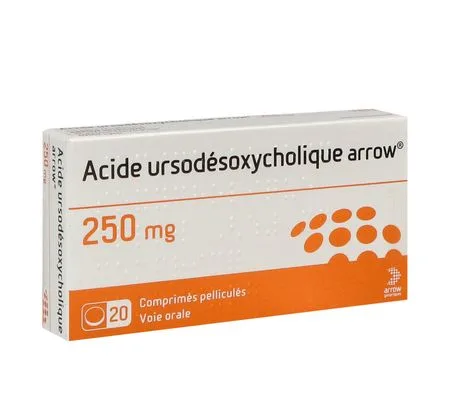
URSODEOXYCHOLIC ACID ARROW 250 mg, film-coated tablet
Forms and presentations
Film-coated tablet.
White, round, biconvex film-coated tablet with a break bar on one face.
The break bar is only intended to make it easier to take the tablet; it does not divide it into equal doses.
Composition
Ursodeoxycholic acid.........................................................................................................................250 mg
For a film-coated tablet.
Excipient with known effect: glucose.
Tablet core : maize starch, sodium lauryl sulfate, povidone, anhydrous colloidal silica, magnesium stearate.
Film coating : titanium dioxide (E171), anhydrous glucose, hypromellose, propylene glycol.
Indications
Cholestasis
- Primary biliary cirrhosis.
- Primary sclerosing cholangitis.
- Chronic cholestasis of cystic fibrosis.
- Progressive familial intrahepatic cholestasis type III.
- Symptomatic gestational cholestasis.
- Hepatobiliary disorders associated with cystic fibrosis in children aged 6 years to 18 years.
Lithiasis
- Biliary lithiasis of LPAC syndrome (Low Phospholipid Associated Cholelithiasis).
- Symptomatic cholesterol gallstone disease: within a non-sclerotic-atrophic gallbladder with a normal wall, symptomatic, in patients with a contraindication to surgery.
Dosage and administration
Dosage
Cholestasis
The initial dose is in the order of 13 to 15 mg/kg/day. It is recommended to progressively increase the dose in steps to reach the optimal dose after 4 and 8 weeks of treatment, without exceeding the dose of 20 mg/kg/day in primary sclerosing cholangitis (see section Warnings and precautions special warnings and precautions for use).
Primary biliary cirrhosis: 13 to 15 mg/kg/day.
Primary sclerosing cholangitis: 15 to 20 mg/kg/day. Do not exceed the dosage of 20 mg/kg/day.
Chronic cholestasis of cystic fibrosis: 20 to 30 mg/kg/day
Genetic cholestases: 20 to 30 mg/kg/day
Symptomatic cholestasis of pregnancy : 10 to 20 mg/kg/day as continuous treatment until delivery. The maximum daily dosage in cholestasis of pregnancy must not exceed 1000 mg/day, divided into 2 doses morning and evening, at mealtimes.
Child with cystic fibrosis aged 6 to 18 years : 20 mg/kg/day to be divided into 2 to 3 doses, with dosage increased to 30 mg/kg/day if necessary.
Cholesterol biliary lithiasis
The recommended dosage is in the order of 5 to 10 mg/kg/day depending on the patient's weight.
It is recommended to take the treatment either in a single dose in the evening, or in two doses morning and evening.
Method of administration
Oral use.
Contraindications
This medicine must not be used in the following cases:
- acute cholecystitis,
- angiocholitis,
- complete obstruction of the bile ducts,
- sclero-atrophic gallbladder,
- hypersensitivity to the active substance or to any of the excipients,
- failure of hepatoportoenterostomy or absence of restoration of bile flow in the child with biliary atresia.
Warnings and precautions
Special warnings
A long-term clinical trial comparing high-dose ursodeoxycholic acid (28 to 30 mg/kg/day) with placebo showed a higher risk of cumulative treatment failures (death, transplantation, varices, cirrhosis) in patients with advanced primary sclerosing cholangitis. Such failures were not observed with lower dosages. Consequently, the maximum recommended dosage of 20 mg/kg/day must not be exceeded.
This medicine contains glucose. It is contraindicated in patients with glucose-galactose malabsorption syndrome (a rare disease).
Precautions for use
In case of concomitant administration of cholestyramine, to treat pruritus, an interval of at least 4h must be respected between taking cholestyramine and taking ursodeoxycholic acid (see section Interactions).
During the first 3 months of treatment, liver function tests (AST, ALT, Gamma GT) must be monitored every 4 weeks then every 3 months. In addition to identifying responder and non-responder patients, this monitoring will allow early detection of any deterioration in liver function, particularly in patients with PBC treated at an advanced stage of the disease.
Treatment interruption should be considered if a clinically significant increase in the above parameters occurs in patients whose previous liver function was stable.
In patients treated with ursodeoxycholic acid, precautions must be taken to maintain bile flow.
It is recommended to reduce the dosage in case of diarrhoea.
The efficacy of treatment for biliary lithiasis must be verified by ultrasound; it is advised to stop treatment in the absence of efficacy (disappearance of stones) after 6 months.
Interactions
Combinations not recommended
+ Cholestyramine : reduced effect of bile acids, which are bound by cholestyramine and eliminated. Cholestyramine must be separated from ursodeoxycholic acid by a time interval of 4 hours (see section Warnings and precautions).
Associations to be taken into account
+ Ciclosporin: risk of variations in blood concentrations of ciclosporin.
Fertility, pregnancy and breastfeeding
Pregnancy
Given the limited clinical exposure data during the 1 trimester of pregnancy, the use of ursodeoxycholic acid may be considered if the absence of treatment jeopardises the hepatic prognosis. During the 2th and 3th trimesters, the use of ursodeoxycholic acid is possible due to more abundant clinical data.
Breast-feeding
There are very few published data on ursodeoxycholic acid and breastfeeding, but no event has been reported to date in a small number of breastfed children. Use during breastfeeding may therefore be considered.
Adverse effects
The side effects are listed below by system organ class and by frequency. Frequencies are defined as very common (≥ 1 / 10), common (≥ 1 / 100 to < 1 / 10), uncommon (≥ 1 / 1, 000 to < 1 / 100), rare (1 / 10 000 to < 1 / 1 000), very rare (< 1 / 10 000), frequency not known (cannot be estimated from the available data).
Gastrointestinal disorders
Common: pasty stools, diarrhoea
Very rare: right hypochondrial pain during treatment of primary biliary cirrhosis
Hepatobiliary disorders
Very rare: calcified gallstones, decompensation of hepatic cirrhosis, partially reversible upon discontinuation of treatment, when treatment of primary biliary cirrhosis is initiated at an advanced stage.
Frequency not known: jaundice (or worsening of pre-existing jaundice).
Investigations
Frequency not known: increased ALT, increased AST, increased blood alkaline phosphatase, increased blood bilirubin, increased gamma GT, increased liver enzymes, abnormal liver function tests, increased transaminases.
Skin and subcutaneous tissue disorders
Very rare: urticaria
Reporting of suspected adverse reactions
Reporting suspected adverse reactions after authorisation of the medicinal product is important. It allows continued monitoring of the benefit/risk balance of the medicinal product. Healthcare professionals should report any suspected adverse reactions via the national reporting system: National Agency for the Safety of Medicines and Health Products (ANSM) and the network of Regional Pharmacovigilance Centres - Website: www.signalement-sante.gouv.fr.
Overdose
In case of overdose, diarrhoea may be observed. With increasing administered dose, absorption of ursodeoxycholic acid decreases and its faecal excretion increases. The occurrence of other symptoms is unlikely.
Pharmacodynamics
Pharmacotherapeutic class: bile acids (A: alimentary tract and metabolism), ATC code: A05AA02.
Ursodeoxycholic acid is a natural bile acid present in very small quantities in humans. In contrast to endogenous bile acids (chenodeoxycholic, cholic, deoxycholic and lithocholic acids), ursodeoxycholic acid is highly hydrophilic and devoid of detergent properties.
Ursodeoxycholic acid exerts an effect on the enterohepatic circulation of endogenous bile acids: increased biliary secretion, inhibition of their active intestinal reabsorption, decreased blood concentration.
Oral administration of ursodeoxycholic acid in humans modifies the bile acid composition of bile; ursodeoxycholic acid becomes the main bile acid and replaces the potentially toxic hydrophobic endogenous bile acids for hepatocytes and cholangiocytes, facilitating their elimination.
By modifying the composition of bile and hydrophobic bile salts, ursodeoxycholic acid protects hepatocytes and cholangiocytes from the cytotoxicity of endogenous bile acids and inhibits hepatocyte apoptosis. These effects, demonstrated experimentally, may help explain the preventive role of ursodeoxycholic acid on the development of fibrosis, particularly in primary biliary cirrhosis.
In primary biliary cirrhosis, ursodeoxycholic acid exerts an effect on biological parameters: decreases in bilirubinaemia, serum alkaline phosphatase activity, gamma GT, transaminases and serum concentrations of IgM and IgG. Ursodeoxycholic acid slows disease progression, particularly when prescribed at early stages.
In primary sclerosing cholangitis, ursodeoxycholic acid has an effect on biological parameters: decrease in bilirubinemia, serum alkaline phosphatase activity, γ GT, and transaminases, but it has not been shown that it can modify the course of this pathology.
In chronic cholestasis of cystic fibrosis, ursodeoxycholic acid has an effect on biological parameters: decrease in bilirubinemia, serum alkaline phosphatase activity and transaminases.
In gravidic cholestasis, ursodeoxycholic acid improves pruritus, decreases bilirubinemia, serum transaminase activity as well as the bile acid level.
In progressive familial intrahepatic cholestasis type III, ursodeoxycholic acid has an effect on biological parameters: decrease in bilirubinemia, serum alkaline phosphatase activity and transaminases.
Familial intrahepatic cholestasis and intrahepatic cholesterol lithiasis of LPAC syndrome are generally due to mutations of the ABCB4/MDR3 gene.
Paediatric population
Cystic fibrosis
There are clinical data dating back more than 10 years on treatment with ursodeoxycholic acid in pediatric patients suffering from hepatobiliary disorders associated with cystic fibrosis.
It has been shown that treatment with ursodeoxycholic acid can reduce bile duct proliferation, halt the progression of histological damage and could even restore hepatobiliary changes when treatment is started at an early stage of the disease.
In order to optimize the efficacy of treatment, the use of ursodeoxycholic acid should be initiated as soon as the diagnosis of hepatobiliary disorders associated with cystic fibrosis is confirmed.
Pharmacokinetics
Absorption
Ursodeoxycholic acid is passively absorbed in the small intestine. Its absorption depends on dissolution by solubilization in mixed micelles of endogenous bile acids.
Distribution
The first-pass hepatic extraction is 50 to 60%. In the liver, ursodeoxycholic acid is conjugated with glycine and taurine. For ingested doses of 10 to 15 mg/kg/day, ursodeoxycholic acid constitutes 50 to 70% of all circulating bile acids.
Elimination
The elimination half-life is on the order of 3 to 5 days.
Ursodeoxycholic acid is mainly excreted in the feces, the renal route being a minor route of elimination.
Preclinical safety
Studies conducted with acute administration in three animal species (rat, mouse, dog) did not reveal any unexpected effect. Subacute and chronic toxicity studies were conducted in rats and monkeys. In both species, hepatotoxic effects, with functional and morphological changes, were observed at doses far higher than those used therapeutically.
The data obtained during the studies in vitro and in vivo did not reveal any mutagenic, genotoxic or carcinogenic potential.
In the context of non-clinical reproduction and fertility studies (rat, mouse, rabbit), effects were observed at doses far above the doses recommended therapeutically and are of no relevant significance for human clinical use.
Prescription, supply and reimbursement
| Marketing authorisation (AMM) |
|
| Price: |
|
- Indication(s) appearing in the marketing authorisation at the date of publication of this decree
Collection.
26 AVENUE TONY GARNIER
69007 LYON
Tel: 04 72 72 60 72 Tel (toll-free): 0811 65 27 76
contact@laboratoire-arrow.com
http://www.laboratoire-arrow.com/
Source: VIDAL · Updated on 10/11/2026. This information does not replace advice from a healthcare professional.