
Medicines
RCP of 18/03/2022
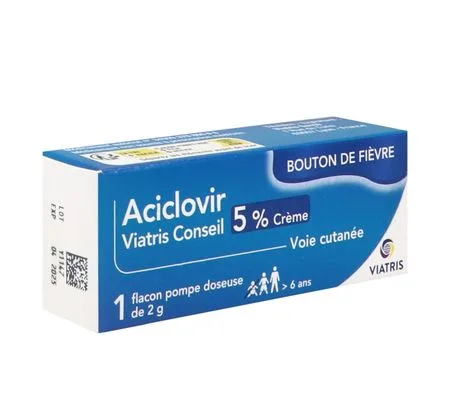
ACICLOVIR VIATRIS ADVICE 5 %, cream
Composition
Aciclovir...........................................................................................................................................................50 mg
For 1 g of cream.
Excipients with known effect: propylene glycol, cetyl alcohol.
Propylene glycol, white petrolatum, liquid paraffin, macrogol stearic glycerides, cetyl alcohol, dimethicone, purified water.
Indications
Treatment of outbreaks of localised herpes labialis (also called "cold sores" or "fever blisters").
Dosage and administration
Reserved for adults and children over 6 years of age.
Dosage
Apply the cream 5 times daily, to the herpetic lesions located exclusively on the lips, each application being spaced at least 3 to 4 hours apart and without nighttime application. It is recommended to apply the cream extending well beyond the lesions.
Treatment is more effective if started at the first symptoms announcing an outbreak of herpes labialis.
The duration of treatment must not exceed 5 days without medical advice.
Wash hands thoroughly before and after applying the cream to the lesion.
Instructions for using the pump :
It is recommended to perform at least 3 to 4 slow and complete presses, so as to fully prime the pumping device from the first use and thus ensure optimal delivery of the product.
Method of administration
Cutaneous use.
Contraindications
- Children under 6 years of age,
- Hypersensitivity to the active substance or to any of the excipients listed in section Composition, or valaciclovir.
Warnings and precautions
Intraoral, ocular or intravaginal application of the cream is not recommended as it may be irritating to mucous membranes. Avoid accidental contact with the eyes.
In profoundly immunocompromised patients (for example, patients with AIDS or patients who have undergone bone marrow transplantation), oral aciclovir treatment should be considered. Such patients should be advised to consult their doctor immediately for treatment of any infection.
Excipients
This medicine contains 150 mg of propylene glycol per 1 g of cream.
This medicine contains cetyl alcohol and may cause local skin reactions (for example, contact dermatitis).
Fertility, pregnancy and breastfeeding
Pregnancy
The use of aciclovir should only be considered if the potential benefits of treatment outweigh possible unknown risks; however, systemic exposure to aciclovir after topical application of aciclovir cream is very low.
A post-marketing pregnancy surveillance registry has documented the outcome of pregnancies in women exposed to any form of aciclovir. The registry results did not show an increase in the number of congenital anomalies in subjects exposed to aciclovir compared with the general population, and the congenital anomalies showed no particular features or elements suggesting a common cause.
Systemic administration of aciclovir had no embryotoxic or teratogenic effect in internationally accepted standard tests in rabbits, rats and mice.
In non-standardised tests in rats, fetal malformations were observed, but only at very high subcutaneous doses associated with maternal toxicity. The clinical relevance of these results is uncertain.
Breast-feeding
Limited data in humans show that aciclovir passes into breast milk after systemic administration. Nevertheless, the dose received by an infant following maternal use of aciclovir cream would be negligible.
Breast-feeding is possible during treatment with this medicine.
Do not apply the cream to the nipples in order to avoid ingestion by the infant.
Fertility
See clinical studies under section. Pharmacokinetics.
Driving and using machines
There are no data concerning effects on the ability to drive vehicles and use machines.
Adverse effects
The following convention has been used for the classification of undesirable effects by frequency: Very common (≥ 1/10); Common (≥ 1/100, < 1/10); Uncommon (≥ 1/1000, < 1/100); Rare (≥ 1/10.000, < 1/1000); Very rare (< 1/10.000).
Data from clinical studies were used to assign a frequency category to the undesirable effects observed during these clinical studies with aciclovir 3% eye ointment. Because of the nature of the observed undesirable effects, it is not possible to determine unequivocally which effects are related to administration of the medicine and which are related to the disease.
Data from spontaneous reports were used as a basis for determining the frequency of effects observed after marketing of the product.
Skin and subcutaneous tissue disorders
Uncommon: Transient tingling or burning sensations following application of the cream, slight dryness or peeling of the skin, itching.
Rare: Erythema, contact dermatitis following application.
During sensitivity tests performed, the excipients present in the cream elicited a greater reactivity than aciclovir.
Immune system disorders
Very rare: immediate hypersensitivity reaction, including angioedema and urticaria.
Reporting of suspected adverse reactions
Reporting suspected adverse reactions after authorisation of the medicinal product is important. It allows continued monitoring of the benefit/risk balance of the medicinal product. Healthcare professionals are asked to report any suspected adverse reaction via the national reporting system: National Agency for the Safety of Medicines and Health Products (ANSM) and the network of Regional Centres of Pharmacovigilance - Website: www.signalement-sante.gouv.fr.
Overdose
No undesirable effects are expected in case of oral ingestion of the entire contents of a tube of 10 g of cream containing 500 mg of aciclovir.
Doses of 800 mg 5 times per day were administered orally for 7 days in the treatment of herpes zoster without adverse effects.
Intravenous administration of a single dose of 80 mg/kg did not cause any adverse effects.
Pharmacodynamics
Pharmacotherapeutic class: antiviral for topical use, ATC code: D06BB03.
Aciclovir itself is a pharmacodynamically inactive compound. After penetration into cells infected with herpes simplex virus (HSV), aciclovir is converted into its active form, aciclovir triphosphate. This conversion is catalysed by the HSV thymidine kinase, an enzyme essential for viral replication. HSV thus ensures the synthesis of its own antiviral agent. The affinity of aciclovir for viral DNA polymerase is 10-20 times higher than its affinity for cellular DNA polymerase.
Aciclovir thus selectively inhibits viral enzymatic activity. Viral DNA polymerase incorporates aciclovir into viral DNA.
Aciclovir lacks a 3'-hydroxyl group; as a result, no further nucleotide can be added by formation of 3'-5' bonds, which leads to chain termination and thus an effective reduction of viral replication.
Both herpes simplex virus species, type 1 and type 2, are highly sensitive to aciclovir.
In profoundly immunocompromised patients, prolonged or repeated treatment with aciclovir may lead to the selection of viral strains with decreased sensitivity. Consequently, these patients will no longer respond to aciclovir treatment.
Pharmacokinetics
Aciclovir penetrates the skin. At steady state, intradermal aciclovir concentrations are above the tissue minimum inhibitory concentration. Aciclovir is not detectable in blood after application to the skin. The results reported below concern oral or intravenous administration.
The main metabolite is 9 -(carboxymethoxymethyl) guanine. It represents 10 to 15 % of the drug excreted via the renal route. The majority of the amount of aciclovir reaching the plasma is eliminated unchanged by the kidneys (both by glomerular filtration and by tubular excretion).
The plasma half-life of aciclovir in patients with normal renal function is approximately 3 hours. Binding to plasma proteins is relatively low (9-33 %).
Interactions through displacement from protein binding sites are therefore unlikely.
Preclinical safety
A large number of tests in vitro showed that chromosomal damage is possible at very high doses. In studies in vivo, chromosomal damage was not observed. Long-term studies in rats and mice did not reveal a carcinogenic effect of aciclovir. In standardised tests according to international standards, systemic administration of aciclovir to different animal species did not cause embryotoxic or teratogenic effects. In a non-standardised test in rats, effects on the foetus were observed only at very high doses that also caused maternal toxicity.
Prescription, supply and reimbursement
| Marketing authorisation (AMM) |
|
1 RUE DE TURIN
69007 LYON
Tel: 04 37 25 75 00 https://www.viatris.fr/
Source: VIDAL · Updated on 10/11/2026. This information does not replace advice from a healthcare professional.