
Medicines
SmPC of the 23/11/2022
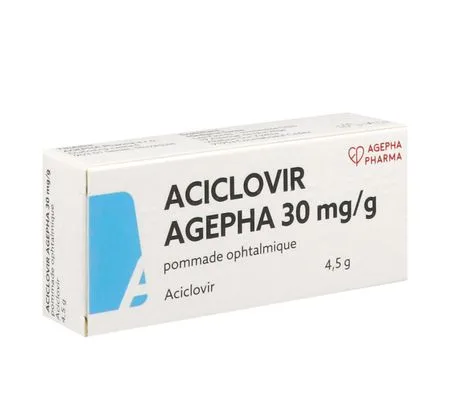
ACICLOVIR AGEPHA 30 mg/g, ophthalmic ointment
Forms and presentations
Ophthalmic ointment.
Homogeneous white or greyish-white ophthalmic ointment.
Composition
Aciclovir..........................................................................................................................................................30 mg
For 1 g of ointment.
White soft paraffin.
Indications
The ophthalmic ointment ACICLOVIR AGEPHA 30 mg/g is indicated for the treatment of keratitis caused by the herpes simplex virus.
Dosage and administration
Dosage
In adults:
Unless otherwise indicated, apply a ribbon of 1 cm of ointment into the lower conjunctival sac of the eye five times a day (approximately every 4 hours). Treatment should be continued for at least 3 days after healing.
Paediatric population
As for adults.
Use in elderly people (over 65 years):
The dosage does not require adjustment.
Use in people with renal and hepatic impairment:
The dosage does not require adjustment.
Method of administration
For ophthalmic use.
Contraindications
Hypersensitivity to the active substance or to any of the excipients listed in section Composition.
Hypersensitivity to valaciclovir.
Warnings and precautions
For ophthalmic use only. Do not administer by injection or by oral route.
There is not enough clinical data on the use of the ophthalmic ointment on deep corneal lesions, nor on the use of the ophthalmic ointment ACICLOVIR AGEPHA in combination with topical corticosteroids.
In case of bacterial co-infection, an additional antibiotic treatment must be prescribed.
Patients must be informed that a slight, transient burning sensation may occur immediately after application of the ointment.
Patients must be informed that wearing contact lenses should be avoided during use of the ophthalmic ointment ACICLOVIR AGEPHA.
Fertility, pregnancy and breastfeeding
Pregnancy
A post-marketing pregnancy registry of aciclovir has documented pregnancy outcomes in women exposed to aciclovir. The registry results did not show an increase in the number of congenital abnormalities described in patients exposed to aciclovir compared with the rest of the population, and no congenital abnormality showed a consistent pattern suggesting a common cause.
Systemic administration of aciclovir in internationally recognised standard trials had no embryotoxic or teratogenic effect in rabbits, rats and mice.
Within the recommended use of ACICLOVIR AGEPHA, no effect on pregnancy is anticipated and the systemic passage of aciclovir is expected to be negligible. If necessary, ACICLOVIR AGEPHA eye ointment may be used during pregnancy.
Breast-feeding
A limited amount of data indicates that the medicine passes into breast milk after systemic administration.
However, the amount absorbed by the breastfed infant following use by the mother of ACICLOVIR AGEPHA eye ointment would be insignificant. Treatment with ACICLOVIR AGEPHA eye ointment may be considered during breastfeeding.
Fertility
No studies have been carried out on the effects of topical ophthalmic use of aciclovir on fertility.
No information is available on the effects of aciclovir on female fertility.
In a study involving 20 male patients with normal sperm counts, aciclovir administered orally at doses of up to 1 g per day for a treatment duration of up to six months showed no clinically important effect on sperm count, motility or morphology. Within the recommended use of ACICLOVIR AGEPHA, the systemic passage of aciclovir is expected to be negligible and no risk to the patient is anticipated.
Driving and using machines
No studies on patients' ability to drive vehicles and use machines have been carried out.
ACICLOVIR AGEPHA eye ointment may affect visual acuity, and caution is advised if you need to drive a vehicle or use a machine.
Adverse effects
Immediately after application of the eye ointment, slight temporary stinging or burning may occur, without this having any impact on the treatment.
Serious adverse effects related to systemic application of aciclovir are rare, and most symptoms are reversible.
Adverse effects are listed below by system organ class according to the Medical Dictionary for Regulatory Activities (MedDRA) and by frequency.
The frequency categories used are:
- Very common: (≥1/10)
- Common: (≥1/100 and <1/10)
- Uncommon: (≥1/1000 and <1/100)
- Rare: (≥1/10 000 and <1/1000)
- Very rare: (<1/10 000)
- Not known: the frequency cannot be estimated from the available data.
Due to the nature of the side effects, it is not possible to clearly determine whether these reactions were caused by the disease or by administration of the medicine. Spontaneous post-marketing reports were used as the basis for determining the frequencies of side effects.
Immune system disorders:
- Very rare: Immediate hypersensitivity reactions, including angioedema (Quincke's oedema, pale swelling of the skin, particularly of the face) and urticaria
Eye disorders:
- Very common: Superficial punctate keratitis. This did not require discontinuation of treatment and symptoms resolved without leaving sequelae.
- Uncommon: Transient burning or slight stinging occurring immediately after application, Conjunctivitis
- Rare: Blepharitis.
Reporting of suspected adverse reactions
Reporting suspected adverse reactions after authorisation of the medicinal product is important. It allows continued monitoring of the benefit/risk balance of the medicinal product. Healthcare professionals are asked to report any suspected adverse reaction via the national reporting system: National Agency for the Safety of Medicines and Health Products (ANSM) and the network of Regional Centres of Pharmacovigilance - Website: www.signalement-sante.gouv.fr.
Overdose
No cases of overdose have been reported. Even if the entire contents of a tube of 4,5 g of ACICLOVIR AGEPHA ophthalmic ointment, which contains 135 mg of aciclovir, were swallowed, no adverse effects would be expected to occur.
Pharmacodynamics
Pharmacotherapeutic class: ANTIVIRAL FOR OPHTHALMIC USE, ATC code: S01AD03.
Mechanism of action
Aciclovir is an analogue of purine nucleosides and has shown in vitro a strong reaction against herpes simplex virus type 1 and 2, and also against varicella-zoster virus
In herpes-infected cells, aciclovir is initially phosphorylated to monophosphate by viral thymidine kinase. Subsequently, it is converted to di- and triphosphate with the help of the cellular enzyme. On the one hand, aciclovir triphosphate inhibits viral DNA polymerase and, on the other hand, it is incorporated into viral DNA in place of deoxyguanosine triphosphate, which disrupts viral DNA synthesis.
Because aciclovir is preferentially taken up by herpes-infected cells and is selectively converted to its active triphosphate form, toxicity to uninfected human cells is low.
Pharmacokinetics
Absorption
Aciclovir is rapidly absorbed by the corneal epithelium and superficial ocular tissues, penetrates the aqueous humour and at this stage reaches a therapeutic level of approximately 7,5 µmol/L
Distribution
It has not been possible to detect the presence of aciclovir in the blood by existing methods after topical application to the eye. However, traces may be detected in the urine. These levels are not clinically significant.
Biotransformation
Aciclovir is metabolised by the enzyme aldehyde dehydrogenase to 9-carboxymethoxymethylguanine.
Elimination
Aciclovir is eliminated by the kidneys, both by glomerular filtration and by tubular secretion.
Preclinical safety
The results of a wide range of mutagenicity tests in vitro and in vivo indicate that aciclovir does not present a genetic risk to humans.
Aciclovir was not shown to be carcinogenic in long-term studies conducted in rats and mice.
Largely reversible adverse effects on spermatogenesis, as well as overall toxicity in rats and dogs, have been reported only at doses of aciclovir far above those used therapeutically. Studies conducted over two generations of mice treated with orally administered aciclovir revealed no effect on fertility.
Systemic administration of aciclovir in internationally recognised standard trials had no embryotoxic or teratogenic effect in rabbits, rats and mice.
Shelf life
5 years.
Chemical and physical stability during use has been demonstrated for 30 days at 25°C.
From a microbiological point of view, once opened, the product may be stored for a maximum of 28 days at 25°C. Different storage durations and conditions are the responsibility of the user.
SPECIAL PRECAUTIONS FOR DISPOSAL AND OTHER HANDLING
Any unused medicinal product or waste material should be disposed of in accordance with local requirements.
Prescription, supply and reimbursement
| Marketing authorisation (AMM) |
|
| Price: |
|
- Indication(s) appearing in the marketing authorisation at the date of publication of this decree
Collection.
LES FJORDS – OSLO BUILDING 19 AVENUE DE NORVEGE
91953 VILLEBON-SUR-YVETTE
Tel: 01 69 59 23 00 medipha@medipha-sante.fr
https://www.medipha-sante.fr/
Source: VIDAL · Updated on 10/11/2026. This information does not replace advice from a healthcare professional.