
Medicines
Update of 24/01/2020
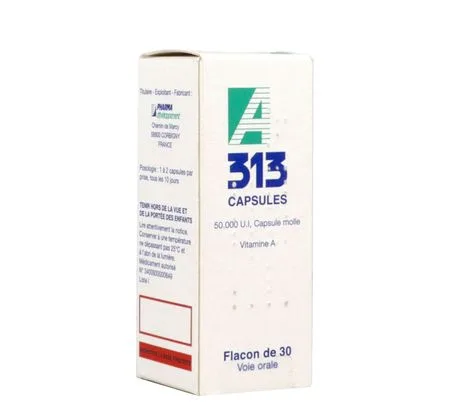
A 313® capsule
retinol
Forms and presentations
Soft capsule (orange-yellow) : Bottle of 30.Composition
| per capsule | |
| Retinol (INN) or synthetic vitamin A, oily concentrate*
|
50 000 IU |
* In the form of retinol palmitate at 1 000 000 IU/g.
Indications
Curative treatment of vitamin A deficiency.Dosage and administration
Reserved for adults and children over 8 years.
1 to 2 capsules per dose, every 10 days, until reconstitution of normal hepatic stores, without unnecessarily prolonging the treatment in order to avoid chronic intoxication (cf Overdosage).
The capsules are to be swallowed as is with a glass of water.
Contraindications
- Hypersensitivity to any of the constituents.
- Disorders of lipid absorption.
- Chronic malabsorption.
- Associated therapy interfering with the absorption of vitamin A.
Warnings and precautions
This medicine contains sorbitol. Its use is not recommended in patients with fructose intolerance.
Due to the presence of sorbitol, this medicine may cause a moderate laxative effect.
To avoid any overdose, take into account the total doses of vitamin A in case of combination of several treatments containing this vitamin.
Interactions
Drug interactionsContraindicated :
- Cyclines, in case of intake of 10 000 IU/day and more: risk of intracranial hypertension.
- Retinoids: risk of symptoms suggestive of hypervitaminosis A.
Fertility, pregnancy and breastfeeding
Pregnancy:Vitamin A is teratogenic in animals in several species.
In the human species, cases of malformations have been reported with high doses. However, to date, the absence of a reliable epidemiological study and the small number of isolated notifications prevent a definitive conclusion on the reality of this malformative risk.
Consequently, vitamin A at high doses will only be prescribed during pregnancy in case of proven deficiency.
Breastfeeding:
Use is not recommended in case of breastfeeding due to the risk of overdose in the newborn.
Adverse effects
Any adverse effect is likely to be a manifestation of overdose and must lead to discontinuation of treatment.
Reporting of suspected adverse effects:Reporting of suspected adverse effects after authorization of the medicinal product is important. It allows continuous monitoring of the benefit/risk ratio of the medicinal product. Healthcare professionals must report any suspected adverse effect via the national reporting system: Agence nationale de sécurité du médicament et des produits de santé (ANSM) and network of Regional Pharmacovigilance Centers. Website: www.ansm.sante.fr.
Overdose
- Clinical signs of acute overdose with vitamin A (doses greater than 150 000 IU):
- Digestive disorders, headaches, intracranial hypertension (manifesting in the infant by bulging of the fontanelle), papilledema, psychiatric disorders, irritability, even convulsions, delayed generalized desquamation.
- Clinical signs of chronic overdose with vitamin A (risk of chronic intoxication during prolonged intake of vitamin A at supraphysiological doses in a non-deficient subject):
- Intracranial hypertension, cortical hyperostosis of long bones and early epiphyseal fusion. The diagnosis is generally made on the observation of sensitive or painful subcutaneous swellings at the level of the extremities of the limbs. Radiographs show diaphyseal periosteal thickening at the level of the ulna, fibula, clavicles and ribs.
Pharmacodynamics
Pharmacotherapeutic class: Vitamin A (ATC code: A11CA01 ; A: Digestive system and metabolism).
Vitamin A is a fat-soluble vitamin. It plays an important role in the formation of visual purple (necessary for adaptation of vision when light decreases), in cell multiplication and epithelial and tissue trophicity.
Pharmacokinetics
Digestive absorption of vitamin A at the level of the small intestine is linked to that of fats.
Hepatic storage is important (at 90 %) and occurs mainly in the form of retinyl esters.
Vitamin A is bound to RBPP (retinol-binding plasmatic protein) formed by the liver.
Elimination occurs via the fecal and urinary routes in the form of derivatives.
Storage conditions
- Shelf life
- 2 years.
Store at a temperature not exceeding 25 °C and protected from light.
MODALITIES HANDLING/DISPOSAL
No special requirements.
Prescription, supply and reimbursement
LIST I| MA | 3400930000649 (1949, SmPC rev 30.04.2014). |
| Price: | 2,55 euros (30 capsules). |
| Soc. Sec. reimbursement at 65 %. Collect. | |
PHARMA DEVELOPPEMENT SA
Marcy Path. 58800 Corbigny
Tel : 03 86 20 21 64
Website : http://www.pharmadeveloppement.com
Source: VIDAL · Updated on 10/11/2026. This information does not replace advice from a healthcare professional.